Table of Contents: How Much Does AI Cost on the WhatsApp Business API?
The previous two articles in this series explained how much you’ll pay per message and how to structure your conversation to minimize the number of messages needed. This one addresses the question that naturally follows: if every reply has a cost, who or what should write it? If you haven’t read them yet, start with the WhatsApp Business API price changes and how to lower that bill.
How much does AI cost on the WhatsApp Business API, depending on who you ask?
Starting October 1, 2026, every response within the 24-hour window incurs a cost. However , the cost varies depending on who writes the response. Whether the response comes from a person, a bot, or a third-party AI, Meta charges the same service fee per message. If Meta’s AI agent responds, Meta charges for the tokens consumed by that message, and the service fee is not added.
On top of that, there are costs that don’t appear on Meta’s invoice: your team’s hours, the AI model’s resource usage (if it’s from a third party), and the cost of setting up each option. That’s why the question is no longer just how many messages you send, but how much each response method actually costs you.
What is a token, and what does AI read before responding?
AI models don’t read words; they read tokens: small fragments of text consisting of just a few characters. In Spanish, a word usually takes up one or two tokens, so 1,000 tokens are roughly equivalent to between 600 and 750 words, depending on the model.
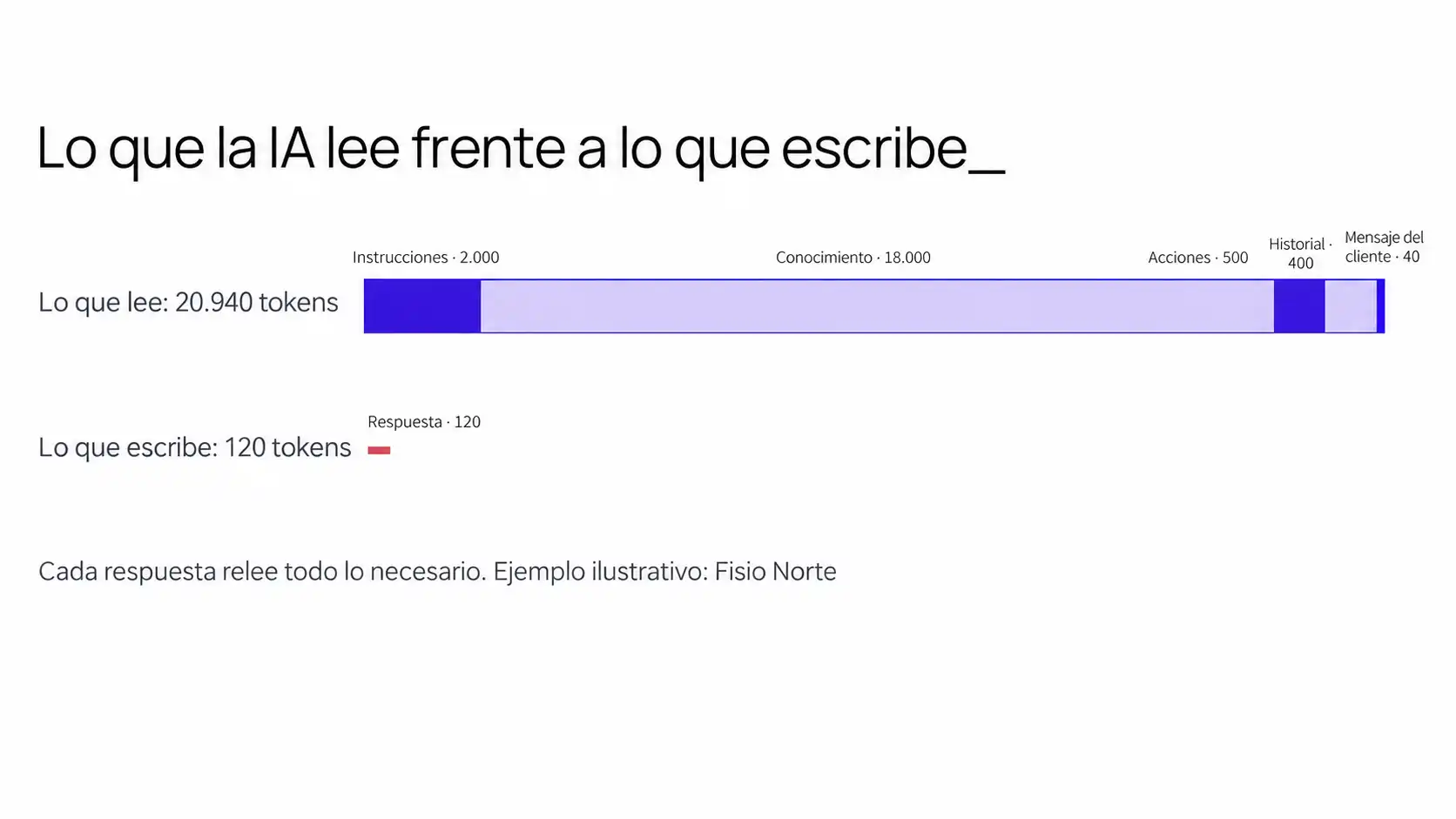
What matters is what the AI reads each time it responds. It doesn’t just read the customer’s last message: in each turn, it re-reads everything it needs to respond.
- Instructions. Tone, rules, and what it can do. Between 500 and 2,000 tokens.
- Knowledge. Frequently asked questions, catalog, pricing, or CRM data. From 500 to 20,000 tokens, depending on how it’s organized.
- Stocks. What you can do: create an appointment, check on an order. Up to 1,500 tokens.
- History. What we’ve discussed so far. It grows with each session.
- Message from the customer. What you just wrote: between 20 and 60 tokens.
- Answer. What AI generates: between 80 and 200 tokens. That’s all it writes; everything else it reads.
That’s why, even though output tokens are more expensive per unit, the bulk of the cost comes from reading. An AI that reads 20,000 tokens to write 120 pays almost entirely for what it reads.
The Four Ways to Reply on WhatsApp
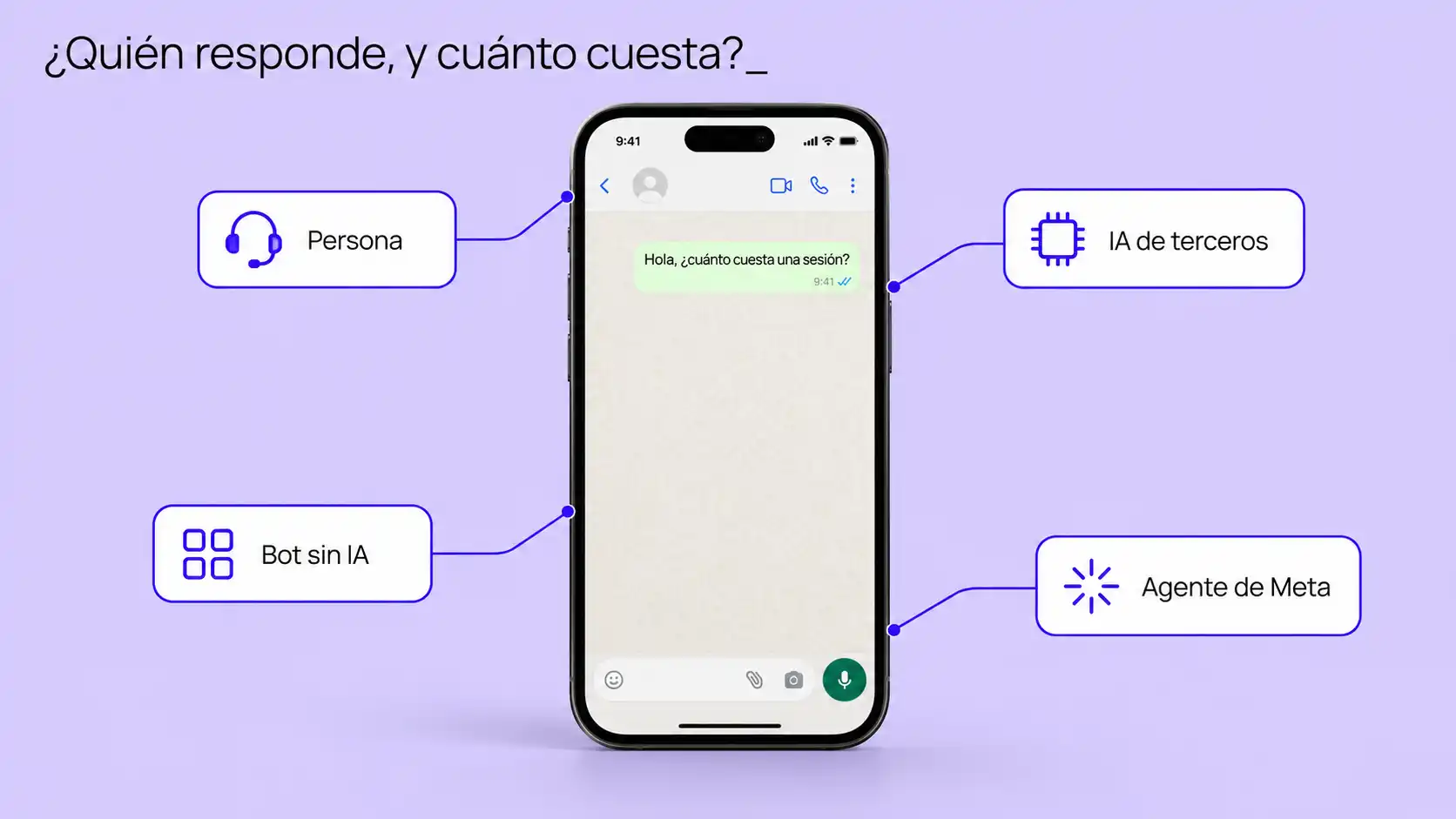
There are four ways for a message to receive a reply, and they can be combined in the same message. Each has a different cost profile:
| Alternative | What Meta Charges Per Response | What Is Charged Separately | How much does it cost to get it up and running? |
|---|---|---|---|
| People | Service fee (€0.0166 in Spain) | The Team’s Schedule | Organize the team and the shared folder |
| Bot without AI | Service Fee | No response, other than the platform’s license | Design, configure, and maintain the workflow |
| Third-party AI | Service Fee | The AI provider’s tokens and, if applicable, the platform’s AI module fee | Configure the assistant, organize knowledge, integrate it with the CRM, and monitor it |
| Meta AI Agent | No service fee: a single charge for tokens ($2 per million) | Nothing | Load the knowledge base, configure the agent, and monitor it |
People
An agent on the team reads, makes a decision, and responds. This is the most flexible option and the only one that effectively handles ambiguity, negotiations, or sensitive complaints. Its cost consists of two parts: Meta’s service fee for each response and the time the agent spends on it. Assuming 2 minutes per response and a cost of €22 per hour, each response costs about €0.73 in labor, compared to €0.0166 from Meta’s fee.
Bot without AI
A conversational flow with buttons, lists, WhatsApp Flows, and predefined responses. It’s the most cost-effective option per response when the question is predictable—such as hours of operation, location, or order status—because it doesn’t add AI costs to Meta’s pricing. Its real cost lies in the time it takes to design, configure, and keep it up to date. And it falls short as soon as the question strays from the script.
Third-party AI via a platform
An AI model from OpenAI, Google, Anthropic, or another provider, connected to WhatsApp through your platform—Woztell, Blip, Spoki, or another. Here, the cost is broken down into two charges: Meta’s service fee, just like in the previous options, and the AI model’s usage. That usage depends on how many tokens the chosen model processes, which in turn depends on what tasks it has to perform in each response.
Prices vary widely depending on the model. A basic model costs twenty times less than a high-end model from the same manufacturer, and for customer service purposes, the basic model is usually sufficient.
Meta AI Agent
Meta’s proprietary AI agent, integrated into the WhatsApp Business platform. It combines AI and delivery into a single fee: Meta charges $2 per million tokens, with no service fee and no separate invoice from an AI provider.
The trade-off is cost. According to Meta itself, a message typically consumes between 20,000 and 25,000 tokens, about 4–5 cents (between 3.5 and 4.4 euro cents). Simple replies consume fewer tokens, but even their example of a simple question uses around 20,000 tokens per message. Furthermore, you don’t choose the model or control what the AI reads in each turn, so the outcome depends on how it behaves in your specific case.
Two exceptions that change the equation
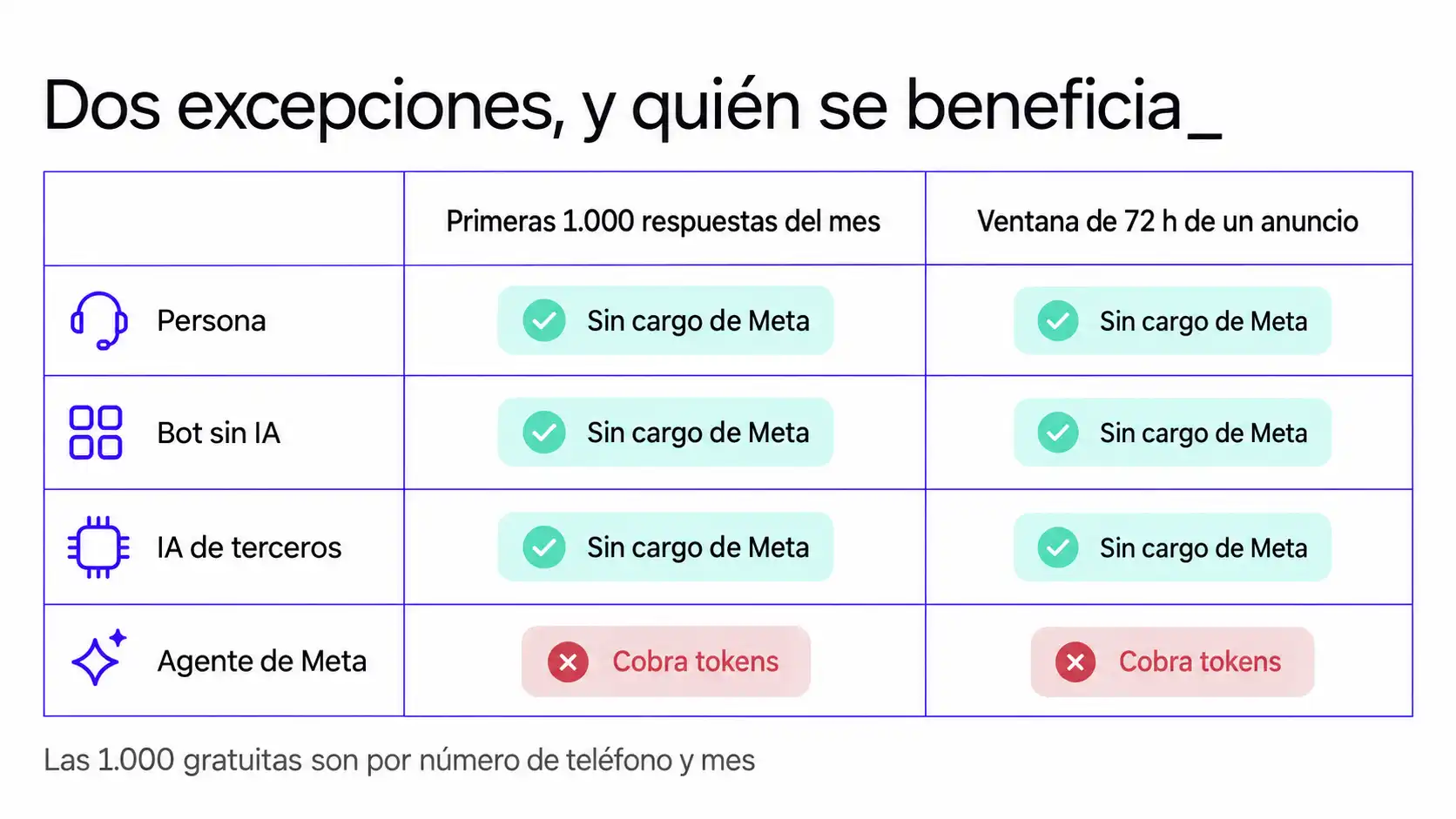
The first 1,000 service responses per month are free per phone number. Below that volume, a person, a bot, or a third-party AI does not pay Meta anything for responding. A Meta agent, on the other hand, charges by tokens starting with the first message.
The second is the 72-hour window for Click-to-WhatsApp: when a customer arrives from an ad and you respond within 24 hours, message delivery is free for 72 hours. However, Meta clarifies that messages sent by your agent are still charged by tokens within that window. If a significant portion of your traffic comes from ads, the scales tip in favor of the other three options. We explain this in point 6 of our guide on how to reduce the cost of the WhatsApp Business API.
Five Cases: How Much Do 1,000 Responses Cost?
For comparison, we have calculated five illustrative scenarios, using fictional businesses and conversations but based on actual rates as of September 23. All figures are per 1,000 responses, starting with the 1,001st response of the month, in euros and excluding VAT.
| Case | What does it do? | Tokens it reads in response | Lightweight AI + Service | Advanced AI + Service | Meta Agent |
|---|---|---|---|---|---|
| 1. Sonrisa Clinic | Frequently Asked Questions About Appointments and Pricing, Short Conversations | 1.650 | 16.79 € | €20.36 | 35–44 € |
| 2. Lúa Store | Catalog, customer data in the CRM, and returns | 9.250 | 17.47 € | 34.09 € | 35–44 € |
| 3. Fisio Norte | All the knowledge gained during each shift | 20.940 | 18.48 € | 54.39 € | 35–44 € |
| Case | How does it respond? | Cost per 1,000 responses |
|---|---|---|
| 4. Mar Azul Hotel | Bot without AI: Menus, Buttons, and Flows | €16.60 (service fee only) |
| 5. Vega Consulting | One person responds (assumption: 2 minutes per response at €22 per hour) | ≈ 750 € (733 € for labor + 16.60 € for service) |
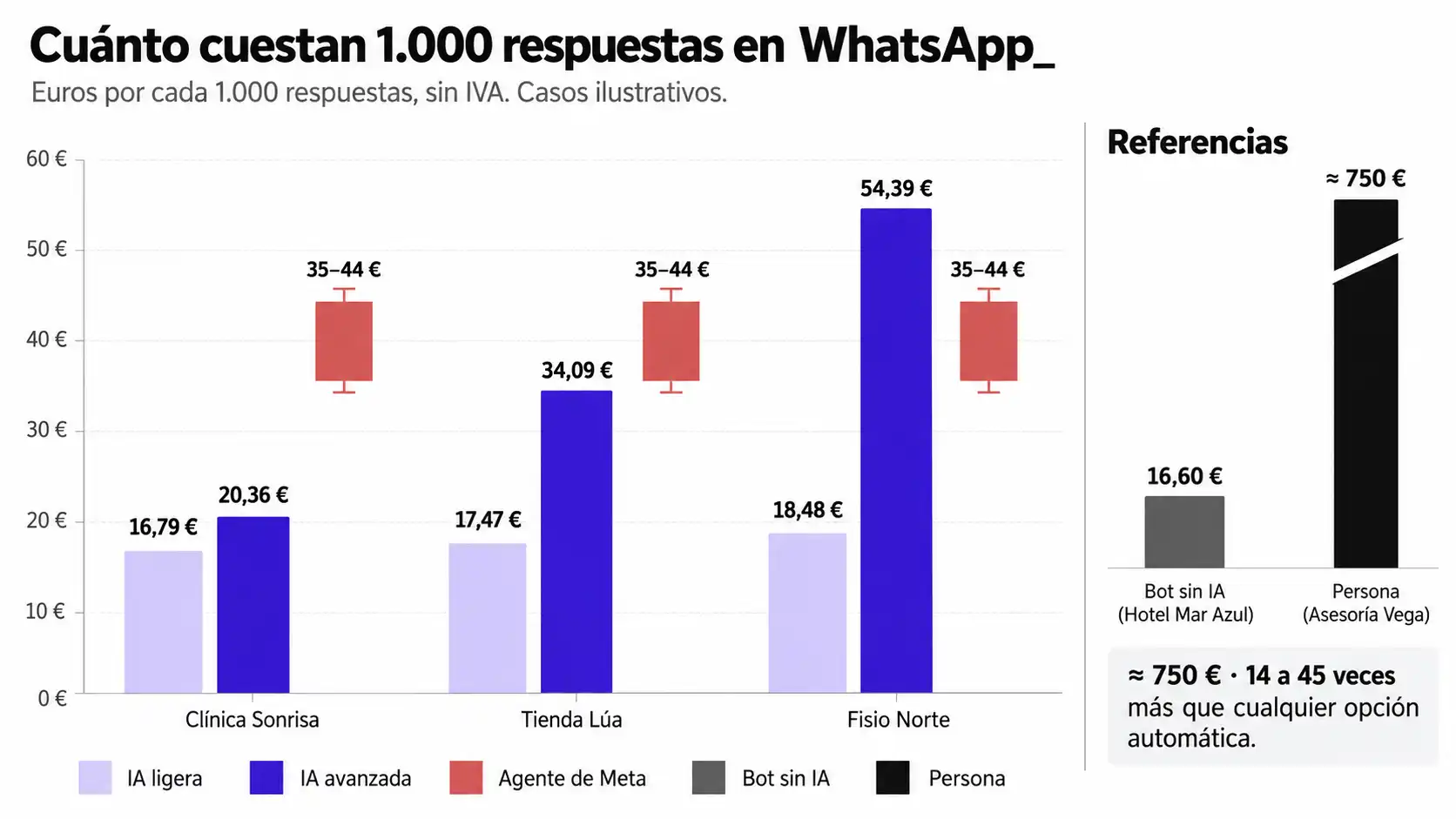
With a lightweight AI, almost all of the cost comes from Meta: of the clinic’s €16.79 charge, €16.60 is for service messages and just €0.19 is for tokens. The model and configuration start to take a toll when using advanced AI or when the assistant reads too much, as in Case 3.
And the biggest difference isn’t between the automated options—it’s compared to a person: a human response costs between 14 and 45 times more than any of the automated ones. The savings from automation aren’t in the tokens—they’re in the hours it frees up for what truly requires a person.
How we calculated it:
- Lightweight AI: OpenAI’s GPT-6 Luna ($0.10 per million input tokens and $0.50 per million output tokens).
- Advanced AI: GPT-6.1 Sol ($2 and $10)
- Meta Agent: the usage benchmark published by Meta, ranging from 20,000 to 25,000 tokens per message at $2 per million, because usage does not depend on how you configure the assistant. Service fee in Spain: €0.0166.
Exchange rate: 1 € = 1.14 $. Prices change several times a year: check them before making a decision.
Is Meta’s agent cheaper than a third-party AI?
It depends on the situation, and it’s not black and white. Here are two examples from the table:
- Meta is more expensive. At the clinic, a lightweight third-party AI costs €16.79 per 1,000 responses, including the service fee. Meta’s agent costs between €35 and €44—more than double that amount.
- Meta is cheaper. At Fisio Norte, with all the data loaded and advanced AI, the third-party option comes to €54.39. There, Meta’s agent, priced at €35–44, is the most economical option.
Meta itself reaches a similar conclusion in its comparison: a simple third-party AI is cheaper than its own agent, while a complex one is more expensive. Another advantage for third-party providers is the 1,000 free responses per number and the 72-hour window for ads. An advantage for Meta is that it’s a single provider and a single invoice.
And price shouldn’t be the only deciding factor. Other factors carry just as much—or even more—weight: the quality of the responses, integration with your CRM, control over what the bot says, and how it hands the conversation off to a human.
How to Make Third-Party AI More Affordable: The Example of Fisio Norte
Let’s go back to Case 3. It’s an illustrative example, but it’s a very common pattern in hastily built chatbots. A customer asks, “How much does a session cost?” Here’s how the text the AI has to read to answer that same question changes, depending on how it’s configured:
| Before · 20,940 entry tokens | After optimization · 4,140 input tokens | |
|---|---|---|
| Instructions | 2,000 tokens: the complete assistant’s guide, with two pages of examples for each shift | 900 tokens: just the answers; the examples are in a separate document |
| Knowledge | 18,000 tokens: the entire database, including treatments, prices, insurance, hours, the 3 centers, and the 9 physical therapists | 2,500 tokens: fragmented knowledge base; only the 3 fragments requested in the question are returned (sessions, vouchers, and insurance) |
| Actions | 500 tokens: all 8 available stocks, even if the question is about prices | 300 tokens: only “schedule an appointment” and “see a representative” |
The response the customer receives is the same. What changes is what the AI reads in order to write it: five times less. These are the factors:
- Retrieve only what’s relevant. The technique is called RAG (Retrieval-Augmented Generation): knowledge is broken down into fragments, and for each question, only the necessary ones are sent. It’s the lever with the greatest impact.
- Brief instructions. Keep the rules concise, and include lengthy examples outside the main message.
- Actions Based on Intention. If the question is about prices, the AI doesn’t need to evaluate the eight actions it knows how to perform.
- Input cache. Vendors charge much less for the fixed portion that repeats in each turn when reading from cache. In OpenAI, caching is applied automatically; in Gemini, it is implicit; and in Anthropic, you have to specify which part to save.
- Fewer shifts. Buttons and WhatsApp Flows shorten the conversation—and, as a result, the chat history that needs to be reviewed. We discuss this in our article on how to reduce the cost of the WhatsApp Business API.
- Short answers. Two or three sentences, without repeating the question: the token is the most expensive one.
The table shows the first three adjustments, which bring the total to 4,140 tokens. If the conversation and the responses are also shortened, the total drops to 3,935. Here is the savings for each adjustment:
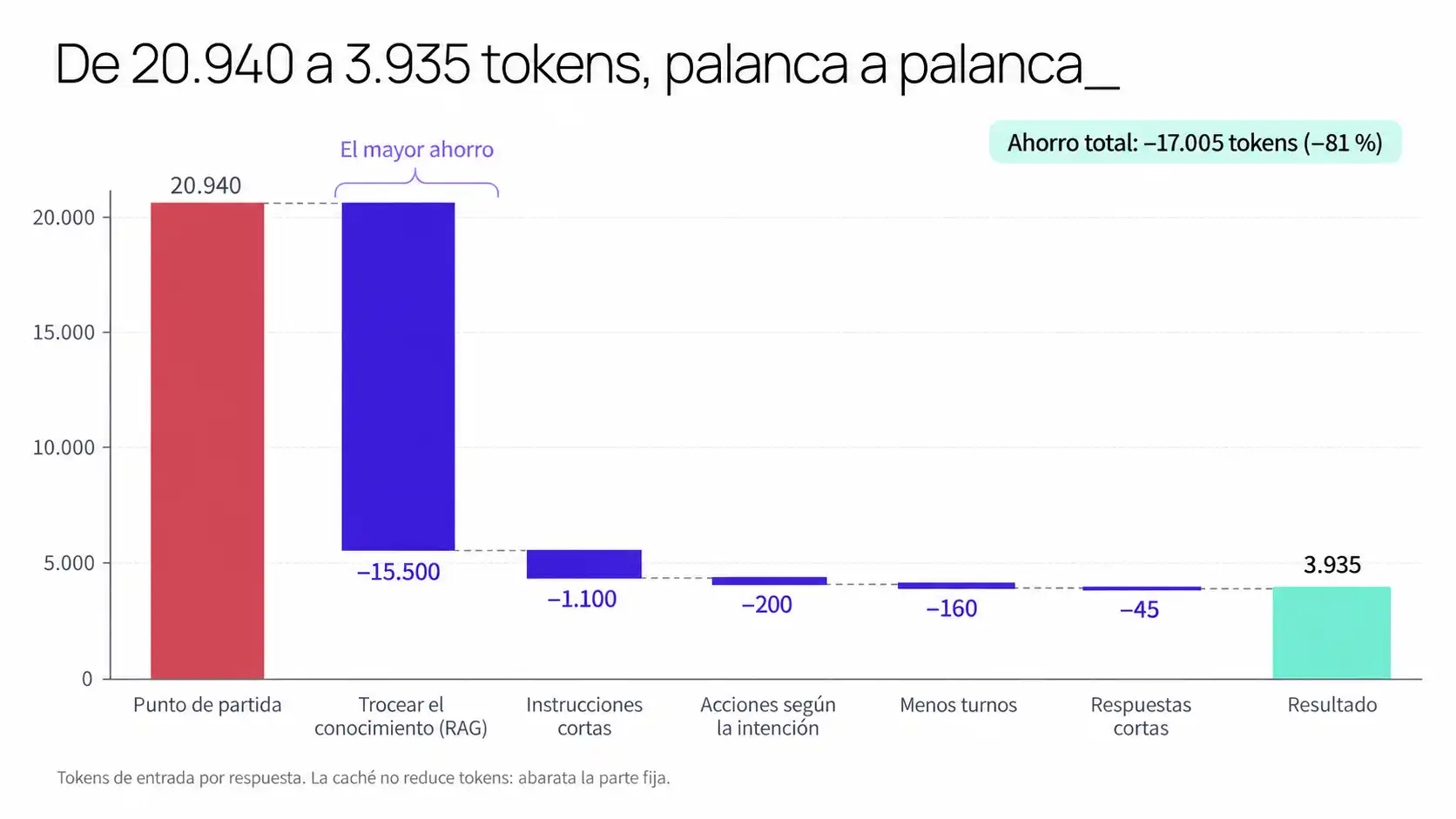
The effect depends on the model. With advanced AI, the cost drops by more than half: from €54.39 to €24.29 per 1,000 responses, without using a cache. Caching doesn’t always add value to RAG: it lowers the cost of repeated content, but with a good RAG, each question brings different snippets, so caching is less effective—meaning the two sometimes compete. We’ll compare this with figures on how to optimize an AI chatbot on WhatsApp using RAG and caching. With a light cache, the difference is barely noticeable, because almost everything is covered by Meta’s fees. And with Meta’s agent, the margin is much smaller, because Meta is the one that manages what its AI reads. In short: a well-designed AI reads only what it needs.
Which option is best for your situation?
There is no option that always wins. The decision depends on three questions:
- How much does the question vary? If most conversations boil down to the same five questions, a bot without AI can handle them just as well—and without the cost of AI.
- Do you have your knowledge organized? An AI needs information that is broken down into manageable chunks and easily accessible. Without that, it reads too much and costs more than it should.
- What happens when the conversation gets complicated? No automated option should be left to handle a serious complaint or negotiation on its own. In such cases, a person is still the best choice.
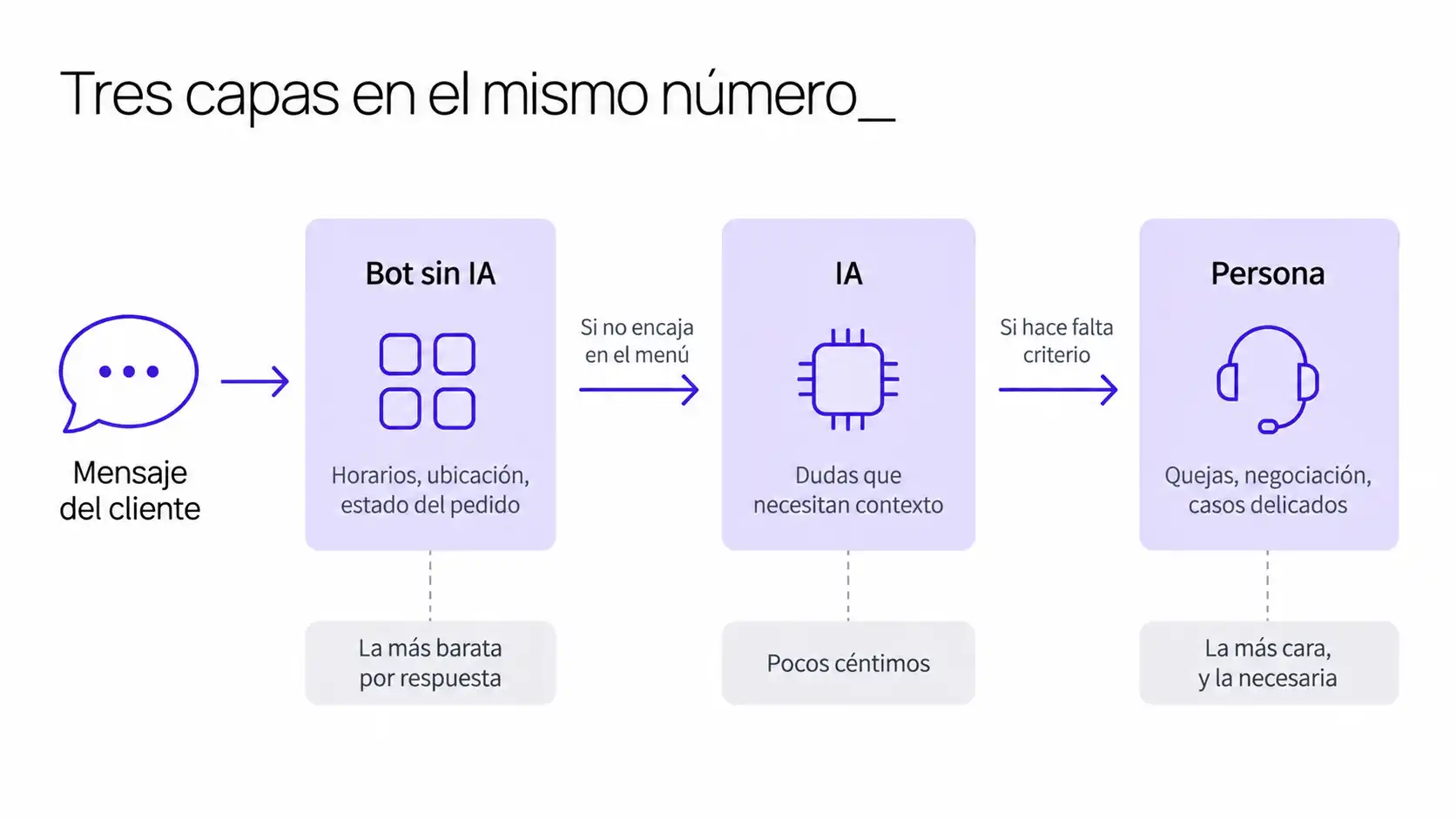
In practice, companies that provide good customer service via WhatsApp combine three layers under the same number:
- A bot for the predictable,
- an AI—whether Meta’s or a third-party one—that requires context,
- and people—situations that require sound judgment. Designing that combination—and the assistant behind it—is what we do in our AI-powered chatbot service, integrated with the WhatsApp Business Platform.
If you want to put some numbers to your case, our WhatsApp cost calculator estimates your Meta bill starting October 1 and the team hours you save by automating responses:
How much will your WhatsApp Business API bill go up?
Since October 1, Meta charges for service replies. Enter the figures for a typical month and see right here how much your bill changes.
- €0.0028per service reply (United States), from the 1,001st reply of the month
- 1,000free replies a month per number
- €0.0265per marketing template (United States)
Meta's official price per marketing message (United States) is €0.0207; the rest is the usual platform and reseller margin. Service replies carry no margin.
Preguntas frecuentes
¿El agente de Meta es más caro que una IA de terceros?
Depende. Frente a una IA ligera de terceros bien configurada, el agente de Meta suele salir más caro: en nuestros casos, más del doble. Frente a una IA avanzada que lee demasiado en cada turno, puede ser al revés. Compara siempre con tus volúmenes reales.
¿Puedo mezclar un bot sin IA con una IA en el mismo número?
Sí, y es lo habitual. El bot resuelve las preguntas cerradas y deriva a la IA o a una persona cuando la conversación se sale del guion. Así no pagas IA por preguntas que un árbol de decisión ya resuelve.
¿Qué pesa más en la factura, los tokens de entrada o los de salida?
Por unidad, los de salida: suelen costar varias veces más que los de entrada (cinco veces en los modelos de OpenAI que usamos en el ejemplo). Pero por respuesta pesan más los de entrada, porque la IA lee mucho más de lo que escribe: en el caso de Fisio Norte, 20.940 tokens leídos para escribir 120. Por eso lo que más ahorra en WhatsApp es recortar lo que lee.
¿Las 1.000 respuestas gratuitas cuentan también si responde una IA?
Sí, si es una IA de terceros, un bot o una persona: son mensajes de servicio y entran en el tramo gratuito. El agente de Meta es una categoría distinta y se cobra por tokens desde el primer mensaje.
¿Un bot sin IA puede sonar tan natural como uno con IA?
No en la conversación libre, pero para preguntas cerradas la diferencia que nota el cliente es mínima. Ahí, pagar de más por IA no compra mejor experiencia, solo más factura.
We design the AI assistant that fits your budget—not the one that sounds the most expensive_
About the sources for this article
Meta Rates: Prices for messages without templates (Meta AI agent and service messages) and WhatsApp Business Platform rates. Model pricing: OpenAI API pricing page. Accessed September 23, 2026; exchange rate: 1 € = 1.14 $. The five cases are illustrative examples created by Reinicia, and the hourly labor cost is an estimate.