VeriFactu is the regulation that requires companies and self-employed individuals to issue invoices using software that prevents invoices from being altered or deleted without a trace and, in its VeriFactu mode, sends each invoice to the tax authorities. Its implementation has been postponed until October 2028; until it is published, the effective dates remain January 1 and July 1, 2027.
Table of Contents: VeriFactu—What It Is and When It Becomes Mandatory
What Is VeriFactu, Explained Without Jargon
VeriFactu is the name given to the Regulation on Computerized Invoicing Systems, approved by Royal Decree 1007/2023 of December 5 and technically implemented by Order HAC/1177/2024 of October 17. It stems from Law 11/2021, dated July 9, on measures to prevent and combat tax fraud—commonly known as the anti-fraud law.
The basic idea is simple: the software you use to issue invoices (what the AEAT calls the computerized invoicing system, or SIF) must prevent an invoice from being modified or deleted without leaving a trace. Gone are the days of software that allows you to keep two sets of books or make sales disappear. VeriFactu doesn’t so much change the invoices you issue as it does the tool you use to issue them.
The Two Modes: VeriFactu and Non-VeriFactu
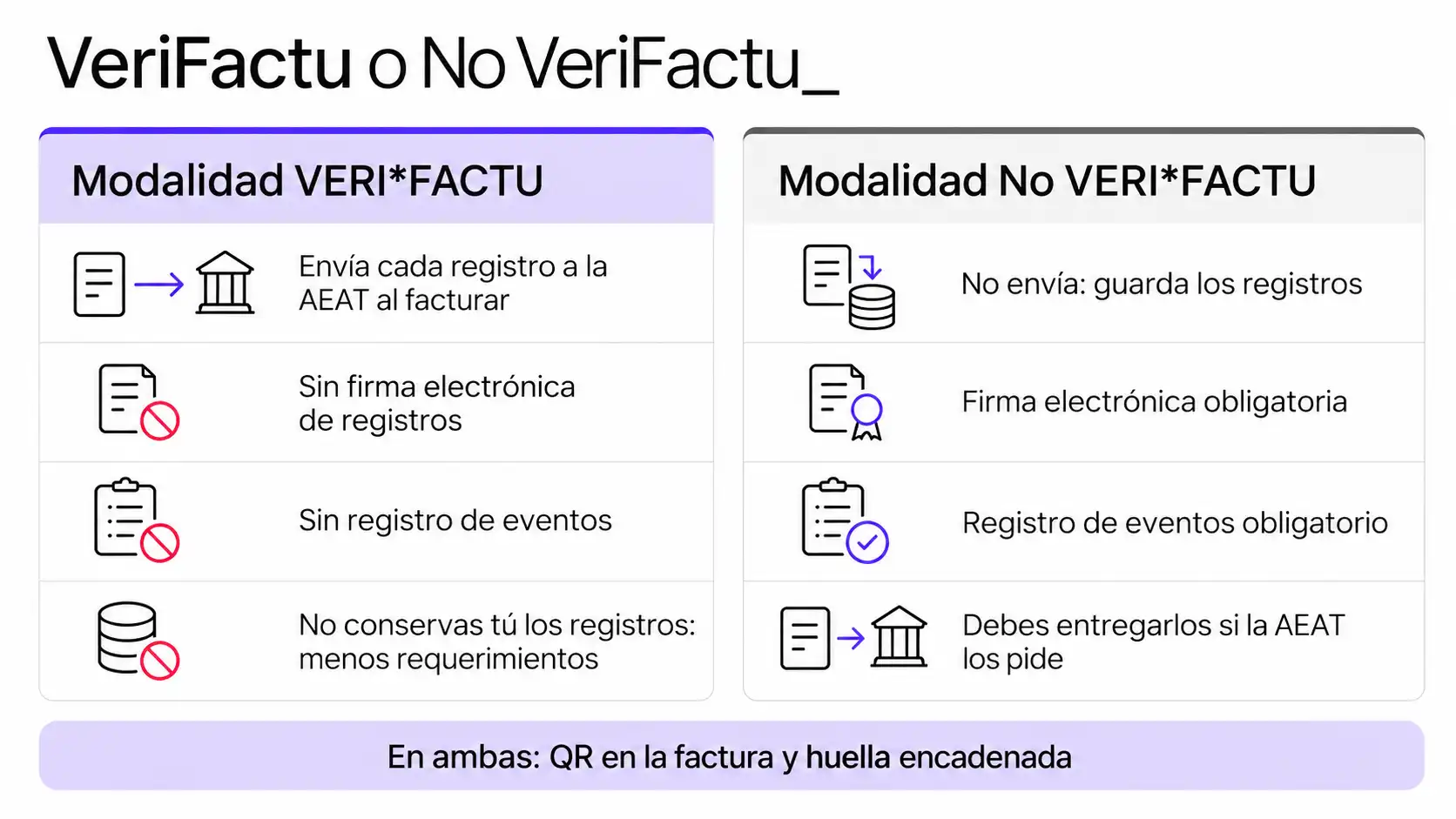
The regulation allows for compliance in two ways, and the choice depends on what your invoicing program offers, which may include one or both:
- VERI*FACTU* mode (the official name includes an asterisk): The program sends a record of each invoice to the AEAT at the time it is issued. In return, you do not have to electronically sign the records, maintain an event log, or retain them for years.
- Non-VERI*FACTU Mode (or “non-verifiable”): The program does not send anything at this time. It stores the electronically signed, chained records along with an event log, and must provide them if the AEAT requests them.
According to the AEAT, the VeriFactu method reduces your workload: you won’t receive requests to submit records, and your customers can verify on the electronic portal that the invoice is on file with the tax authorities. If you choose this method after you’ve already become subject to the requirement, you must continue using it at least until the end of the calendar year in which you make your first submission. Before your legal deadline, you are in the voluntary period and may stop submitting invoices.
What an invoice must include (QR code, digital signature, registration)
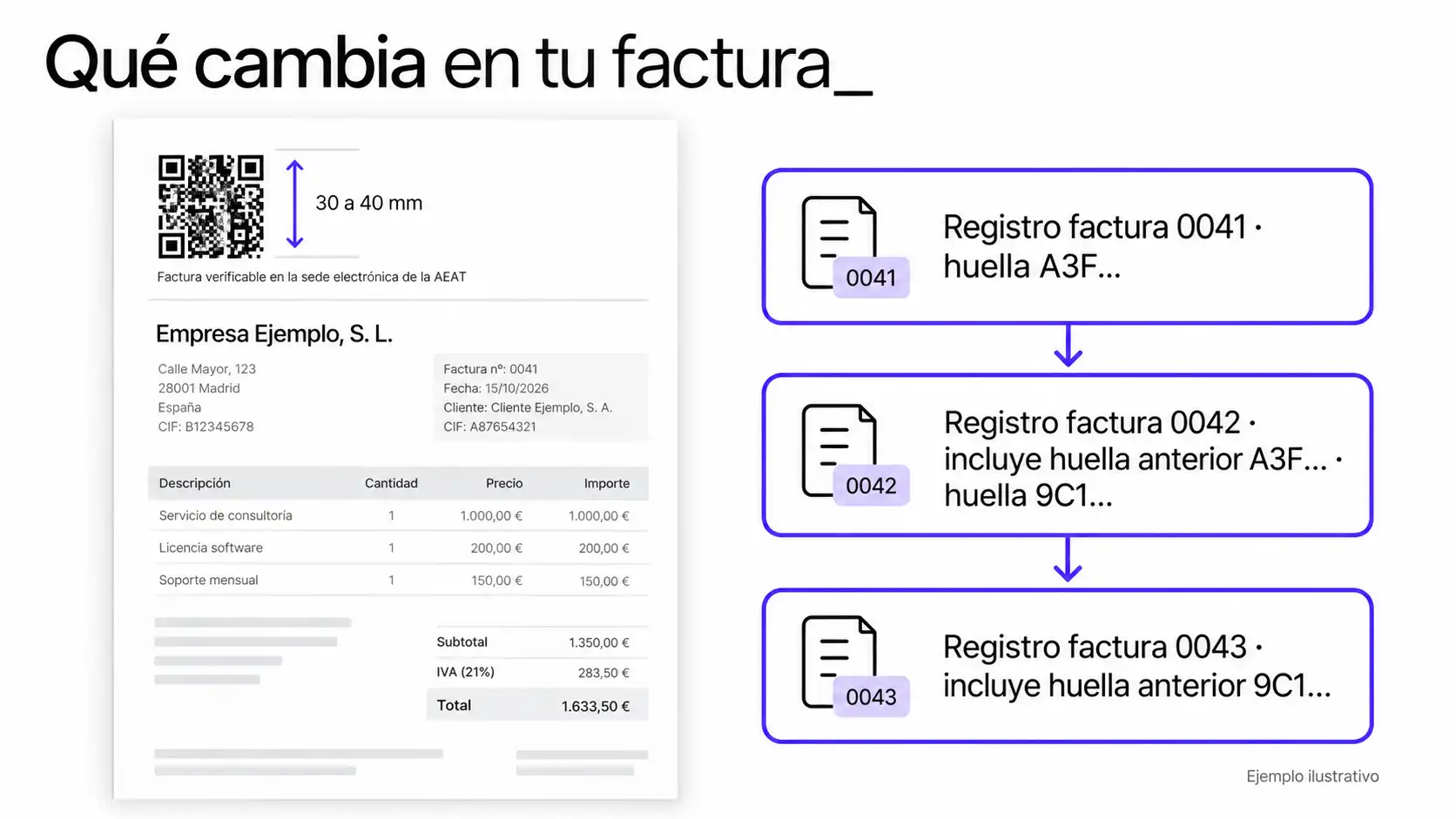
For your customer, the visible change is a QR code. Behind the scenes, each invoice consists of three components:
- Invoicing record: the set of invoice data (issuer, number, date, amounts, etc.) that the program generates when issuing the invoice. If you void it, the program generates a voiding record.
- Hash: A code calculated using the SHA-256 algorithm based on the record’s data. Each record includes the hash of the previous one, so they are linked together: if someone alters an old invoice, the chain is broken.
- QR Code: Required on all invoices issued using a compliant program, regardless of the format. It measures between 30×30 and 40×40 mm and appears at the top of the invoice, on the first page. The recipient can scan it and check with the AEAT to see if it has been registered.
Only in the VeriFactu format does the invoice also include the phrase “Invoice verifiable on the AEAT’s electronic portal” or “VERI*FACTU.” In a structured electronic invoice (an XML file), the QR code is not printed: its content is embedded within the file itself, as explained by the AEAT in its section on QR codes.
When It’s Mandatory: Current Dates and the Announced Postponement to October 2028
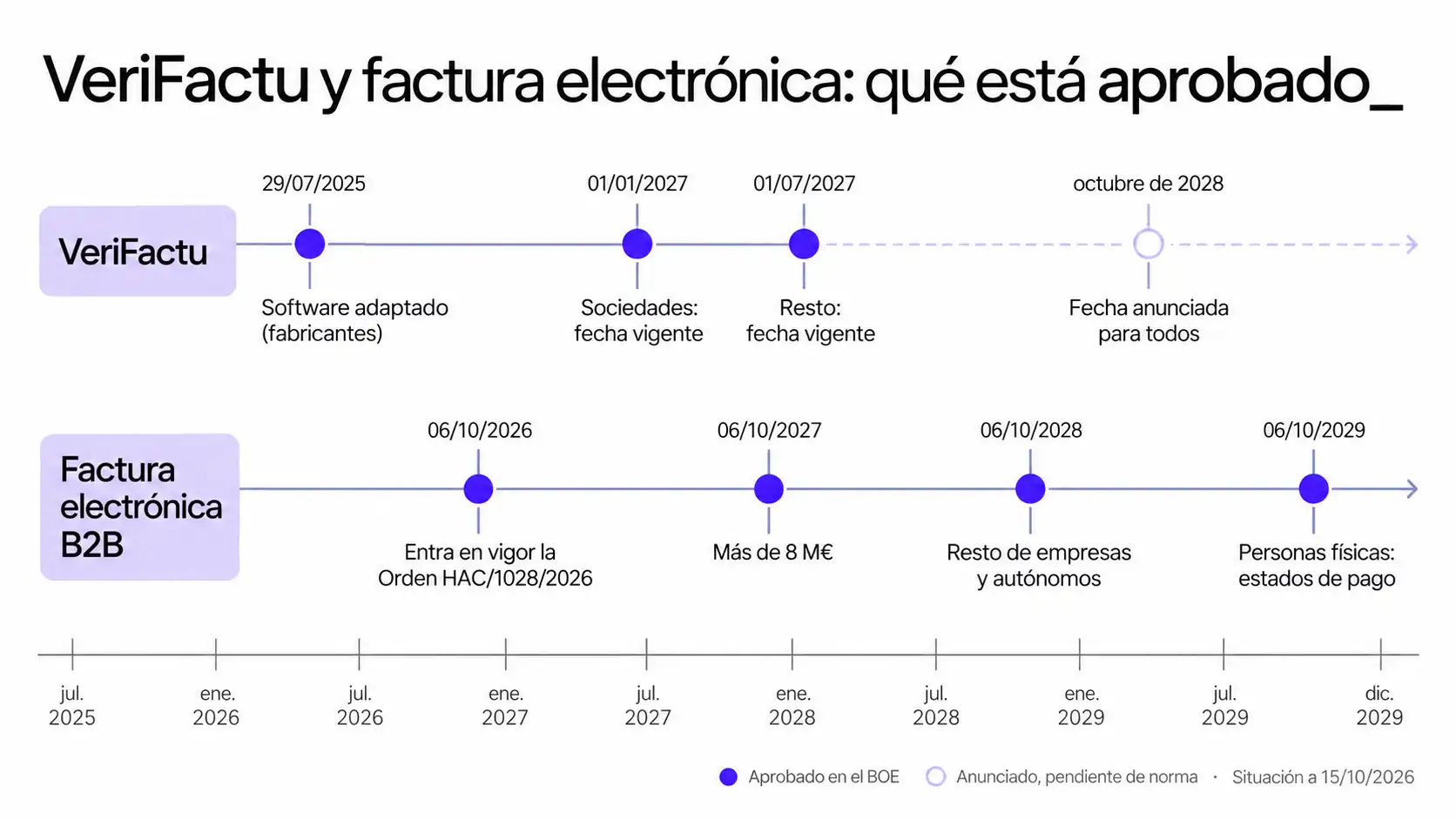
Here’s the confusion this fall. On October 5, 2026, the Ministry of Finance announced in a press release that it plans to postpone VeriFactu’s outstanding obligations until October 2028, so that they coincide with the mandatory electronic invoicing requirement for small and medium-sized businesses and the self-employed. The press release does not specify a particular date.
This wouldn’t be the first change. The original date was July 1, 2025; Royal Decree 254/2025 moved it to 2026, and Royal Decree-Law 15/2025, dated December 2—ratified by Congress on December 11, 2025—set it for 2027.
What Has Been Approved and What Has Only Been Announced
| Group | Effective Date (Approved, in the Official State Gazette) | Announced Date (pending regulation) |
|---|---|---|
| Corporate Income Taxpayers | Before January 1, 2027 | October 2028 |
| Other taxpayers (self-employed individuals and professionals subject to personal income tax, among others) | Before July 1, 2027 | October 2028 |
As of October 26, 2026, the postponement has not been published in the Official State Gazette (BOE). The current text of Royal Decree 1007/2023 maintains the 2027 dates, and the Spanish Tax Agency (AEAT) also reflects this in its notice regarding the extension of the deadline. The Treasury’s own notice explains that the alignment of the schedules will be approved first, followed by an amendment to the regulations, without specifying the type of regulation or when it will take effect.
In practice: Until the regulation is published, the legal deadlines are those for 2027. If you’re a corporation, your official reference date remains January 1, 2027. You can plan ahead with 2028 in mind, but keep an eye on the Official State Gazette (BOE): if the regulation isn’t published by the end of the year, that date will still be enforceable.
The Ministry of Finance states that the technical requirements (integrity, traceability, and immutability) will remain “substantially equivalent,” although it will revise the regulations to bring them in line with electronic invoicing and future European digital VAT obligations (the ViDA package).
What Has Not Been Postponed (Software Adapted Starting in July 2025)
The announcement affects those who sell the software, not those who develop it. Software producers and distributors had nine months from the effective date of Order HAC/1177/2024 (October 29, 2024) to offer their updated products, and that deadline expired on July 29, 2025. Since then, any invoicing software sold to you should comply with the regulation.
The proof is the manufacturer’s declaration of conformity: the certificate that the manufacturer itself signs for each version of its software. The AEAT requires that it be accessible both within the software itself (for example, under “Help” or “About”) and outside of it. If your provider can’t show it to you, that’s already a clue.
Who is required to comply, and who is exempt
Business owners and professionals who issue invoices using computer software are required to comply: companies, self-employed individuals with business income subject to personal income tax, and all other parties required to comply as specified in the regulations. The AEAT summarizes this as the “rule of the four NO’s.” VeriFactu applies to you if:
- Youdo not issue invoices exclusively by hand.
- You arenot enrolled in the SII (Immediate Information Reporting) system.
- Your tax residence isnot in the Basque Country or Navarre.
- You donot have a ruling from the AEAT exempting you.
Nor does it apply to those who are not required to issue invoices. This is standard practice under the simplified, equivalence surcharge, and agriculture, livestock, and fishing tax regimes, except for transactions in which they are required to issue invoices (for example, to another business). If you use software to generate those invoices, it must comply with the requirements.
Companies in the SII
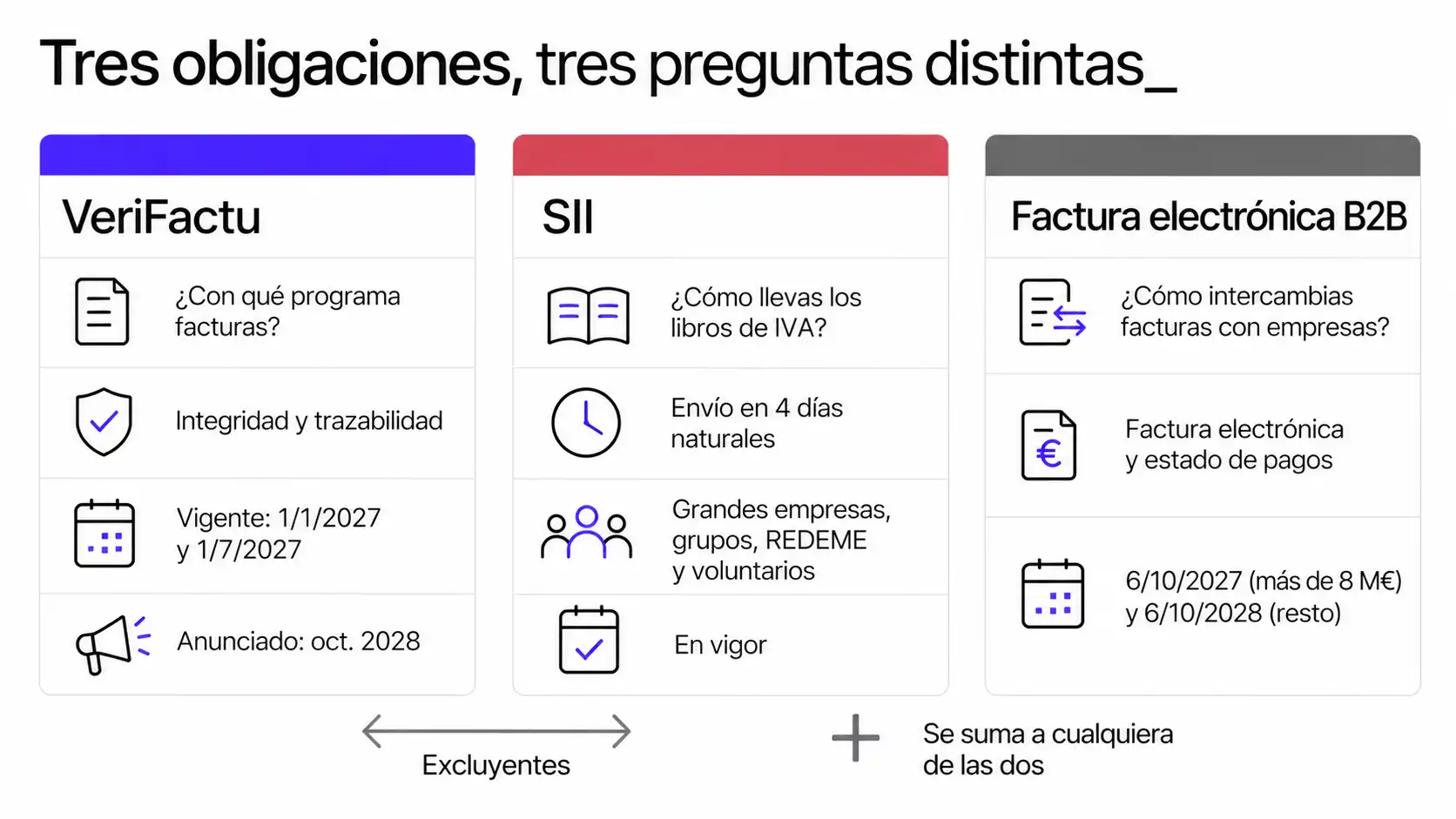
The SII is the process of maintaining VAT records at the AEAT headquarters, submitting the details of each invoice within four calendar days. According to the SII’s FAQs, large companies (with a turnover exceeding €6,010,121.04), VAT groups, and those registered with REDEME are required to participate, and any company may voluntarily opt in.
SII and VeriFactu are mutually exclusive: if you comply with SII, you do not have to comply with VeriFactu regulations, and vice versa. If you switch to SII, you must stop sending records to VeriFactu and stop including the QR code as soon as you are effectively compliant with SII. The analysis is conducted on a company-by-company basis, even if they belong to the same group.
Basque Country and Navarre (TicketBAI and Batuz)
If your tax residence is in Álava, Bizkaia, or Gipuzkoa and you are taxed under the provincial tax code, VeriFactu does not apply to you: your obligation is TicketBAI, a system with similar functionality required by the three provincial councils. In Bizkaia, it is integrated into Batuz, which combines the Economic Transactions Register (LROE) and draft tax returns.
In Navarre, as a general rule, the VeriFactu regulations do not apply to those subject to regional regulations; your obligations are determined by the Navarre Regional Tax Authority. There are some nuances: a regional company that issues invoices on behalf of suppliers located in the rest of Spain (self-billing) may have to comply with VeriFactu for those transactions. If this applies to you, check with your tax advisor.
VeriFactu, SII, and B2B electronic invoicing: they are not the same thing
These are three regulations with similar names that often get mixed up in conversation. The key difference: VeriFactu regulates the software you use to issue invoices, the SII regulates how you maintain your VAT records, and the B2B electronic invoicing regulation governs how you exchange invoices with other companies.
| VeriFactu | SII | B2B Electronic Invoice | |
|---|---|---|---|
| What it regulates | The invoicing program: integrity, traceability, and—if you choose this option—submission to the AEAT | Maintenance of VAT records at the AEAT headquarters | The format and channel for invoices between businesses and self-employed individuals, and the status of their payments |
| Who it affects | Businesses and self-employed individuals who issue invoices using software, outside the SII and the provincial tax territories | Large companies, VAT groups, those registered with REDEME, and voluntary participants | Business owners and professionals in their transactions with one another |
| What is submitted | A record of each invoice is submitted to the AEAT (VeriFactu mode) or retained in signed form (Non-VeriFactu) | A breakdown of invoices issued and received, within four calendar days | The electronic invoice sent to your customer, as well as the status of invoices and payments |
| Timeline | Effective: January 1 and July 1, 2027. Announced: October 2028 | Already in effect | Approved: October 6, 2027 (over 8 million euros) and October 6, 2028 (remaining amounts) |
| Compatibility | Incompatible with the SII | Incompatible with VeriFactu | Can be used in conjunction with VeriFactu or the SII |
Electronic Invoicing Under the Crea y Crece Act and Its Timeline
Law 18/2022, of September 28, on the creation and growth of businesses, requires the issuance, transmission, and receipt of electronic invoices in transactions between businesses and professionals. Royal Decree 238/2026, dated March 25, implemented the law but deferred its deadlines until the technical order was approved.
That order already exists: Order HAC/1028/2026, dated October 2, published in the Official State Gazette (BOE) on October 5, 2026, and effective as of October 6, regulates the Public Electronic Invoicing Solution and sets the clock in motion. According to the AEAT’s implementation schedule:
- October 6, 2027: Business owners and professionals with a turnover exceeding 8 million euros in the previous year. During the first 12 months, they must include a readable PDF with their electronic invoices.
- October 6, 2028: All other business owners and professionals.
- October 6, 2029: Individuals and entities subject to income attribution whose business volume does not exceed that threshold begin reporting on the status of invoices and payments.
Simplified invoices (the old receipts) are excluded, except for qualified simplified invoices. And here’s the key point of the announcement: if approved, October 2028 would be the date when VeriFactu and B2B electronic invoicing come into effect for most small and medium-sized businesses and self-employed individuals. It makes sense to prepare for both at the same time.
What happens if you don’t comply
The penalties are set forth in Article 201 bis of Law 58/2003, the General Tax Law, which introduced the anti-fraud law. These are serious violations subject to fixed fines:
- 150,000 € per fiscal year and for each type of program for anyone who manufactures, produces, or markets software that allows for the maintenance of separate sets of books, conceals or alters transactions, or fails to meet the required specifications.
- €1,000 for each program sold without certification when certification is mandatory.
- €50,000 per fiscal year for any company or self-employed individual that possesses uncertified or altered software.
The first two are aimed at manufacturers and sellers, whose transition period has already ended. The one regarding possession is the one that affects those who issue invoices, and it is linked to the obligation to use a compliant system, which takes effect on your specific date. The Treasury’s notice does not mention any changes to this penalty system.
What to do now, with two years to go
If the postponement is confirmed, you’ll have about two years. Use that time to make the switch once and for all—with both VeriFactu and electronic invoicing in mind—not to put it off. We’ve seen in our projects that what takes the most time isn’t activating a feature in the software, but rather organizing tax data, invoice series, and processes.
Check your invoicing software
- Ask your provider for the self-certification statement for the version you use and inquire about which options they offer: VeriFactu, Non-VeriFactu, or both.
- Ask how they will handle B2B electronic invoicing: formats, connection to the Public Solution or private platforms, and payment status notifications.
- Check your master data: your customers’ tax ID numbers (NIF) and addresses, billing series, and VAT rates. A misspelled tax ID number today means a rejected entry tomorrow.
- If you invoice using Excel or Word and these programs also handle your bookkeeping or accounting, the AEAT may consider them an invoicing system.
- Talk to your tax advisor: If you’re a corporation and the regulation isn’t published before the end of the year, January 1, 2027, would still be your deadline.
If this review leads you to switch tools, approach it as a management project—not just a compliance one: an ERP system that integrates invoicing, accounting, and sales saves you work every day, and that’s what we address in our ERP consulting services. If your company already uses several Zoho applications, it’s a good idea to find out what Zoho One includes and how much it costs before signing up for anything separately.
If you already use Zoho Books
Zoho Books complies with VeriFactu through a third-party provider, B2Brouter, which sends the records to the AEAT. This isn’t a built-in feature; it involves an additional cost and requires some changes to your invoicing practices. We explain this step by step, including costs and details specific to your situation, in our guide to VeriFactu in Zoho Books.
Preguntas frecuentes
¿VeriFactu es obligatorio?
Sí, para quien factura con un programa informático y no está en el SII ni tiene su domicilio fiscal en el País Vasco o Navarra. Lo voluntario es la modalidad: puedes enviar cada factura a la AEAT (VeriFactu) o conservar los registros firmados (No VeriFactu). Las fechas vigentes en el BOE son el 1 de enero de 2027 para sociedades y el 1 de julio de 2027 para el resto, hasta que se publique el aplazamiento anunciado.
¿Se ha aplazado VeriFactu a 2028?
Está anunciado, no aprobado. El 5 de octubre de 2026 Hacienda comunicó que prevé aplazarlo a octubre de 2028 para alinearlo con la factura electrónica B2B. A 26 de octubre de 2026 no hay norma publicada en el BOE, así que siguen vigentes el 1 de enero y el 1 de julio de 2027. Cuando se publique la modificación del Real Decreto 1007/2023, las nuevas fechas tendrán valor legal.
¿Afecta VeriFactu a los autónomos?
Sí, a los que facturan con un programa informático y no están en el SII ni en territorio foral. Su fecha vigente es el 1 de julio de 2027 (octubre de 2028 si se aprueba el aplazamiento). Los autónomos en módulos o recargo de equivalencia no suelen estar obligados a facturar, salvo en algunas operaciones, como las que hacen a otras empresas; si para ellas usan un programa, debe cumplir.
¿Puedo seguir facturando con Excel o Word?
Depende del uso. Según la AEAT, si solo los usas para escribir, imprimir y guardar facturas, no son un sistema de facturación. Si además generan tus libros registro o tu contabilidad (con fórmulas o macros, por ejemplo), sí lo son y tendrían que cumplir todos los requisitos del reglamento (huella encadenada, QR, registros). Y ten en cuenta que facturar con plantillas no te libra de la factura electrónica B2B.
¿Qué diferencia hay entre VeriFactu y TicketBAI?
Persiguen lo mismo (que las facturas no se puedan manipular), pero en territorios distintos. VeriFactu es la norma estatal de la AEAT; TicketBAI es el sistema de las diputaciones forales de Álava, Bizkaia y Gipuzkoa, y en Bizkaia forma parte de Batuz. Quien tributa por la normativa foral vasca cumple con TicketBAI y no con VeriFactu. Navarra tiene sus propias normas forales.
Set up your billing for VeriFactu and electronic invoicing once and for all_
About the sources for this article
Official sources linked throughout the text: BOE (Royal Decree 1007/2023, Order HAC/1177/2024, Royal Decree-Law 15/2025, Law 11/2021, Law 58/2003 General Tax Law, Law 18/2022, Royal Decree 238/2026, and Order HAC/1028/2026), Ministry of Finance (information note dated October 5, 2026), AEAT’s electronic portal (VERI*FACTU and SII FAQs, notice regarding deadline extensions and the electronic invoicing schedule) and Batuz (Provincial Council of Bizkaia). Accessed on October 15, 2026; the status of the deferral in the BOE was reviewed again on October 26, 2026. Dates that have been announced but are still pending regulatory approval are indicated as such; the invoice examples are for illustrative purposes only. This article is for informational purposes only and does not replace tax advice from your tax advisor.