Index
What is CRM?
CRM (Customer Relationship Management) is a software that aims to improve the management and maintenance of relationships with the company’s customers. Through a database fed at each interaction with users, the CRM system identifies behavioral patterns and trends among people who use products and services.
CRM collects and stores valuable company information such as demographics, purchase history, previous interactions and individual customer preferences and organizes this information so that sales, marketing and customer service teams can easily access and use it to deliver more efficient and personalized service, thereby driving business growth.
It is necessary to distinguish the difference between CRM and ERP, as both terms often tend to be confused.
By better understanding customers and their needs, companies can tailor marketing strategies and messages, offer appropriate solutions and anticipate sales opportunities, as well as improve communication and help solve problems faster and more efficiently.
What are the types of CRM that exist?
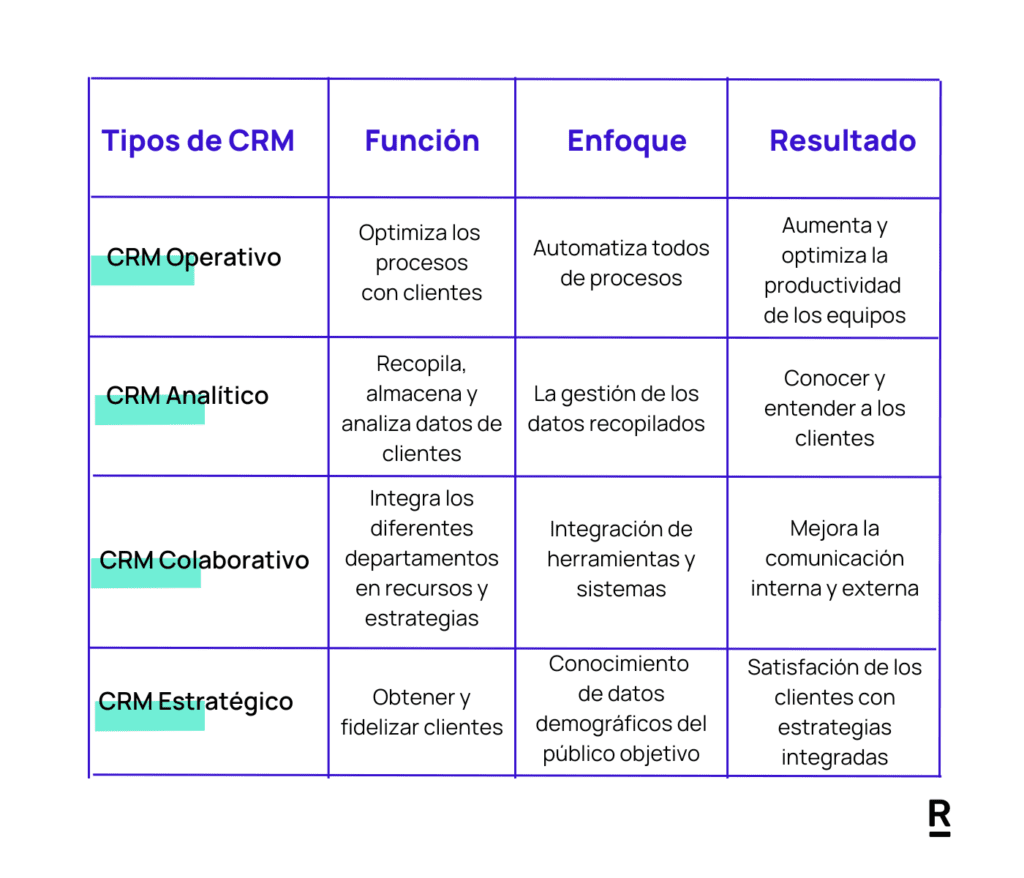
Today, four variants of CRM can be distinguished: Operational, Analytical, Collaborative and Strategic CRM.
All these variants include omnichannel CRM, which allows you to communicate with customers in several ways, without having to leave the CRM itself.
Although they all share the intention of consolidating customer information in one place and streamlining internal processes, each excels in a particular aspect that makes them more suitable for specific contexts.
Operational CRM
It is a system designed to optimize customer-related operations. Its goal is to centralize the activities of different departments in a common interface, fostering collaboration and efficiency.
Among the most prominent features of Operational CRM are process automation tools. These make it easier for professionals to manage repetitive tasks more effectively and in fewer steps.
Analytical CRM
It focuses on collecting, storing and analyzing the data processed by the company. Its objective is to transform significant volumes of information into valuable knowledge for the business strategy.
Among the most notable qualities of analytical CRM is its ability to give you a deep understanding of customers: from their location and age to their buying habits and income.
Collaborative CRM
It serves to synchronize resources and strategies from various departments through a unified interface. In other words, collaborative CRM ensures smooth internal communication, giving all professionals access to the data collected.
One of the outstanding features of this type of CRM is the variety of integration tools available, both between individuals and with other technologies used in your business: Zoho CRM integrates natively with other Zoho applications, enabling greater synchronization and collaboration between different aspects of the business. It also does so with external applications such as Google Apps, Salesforce, Microsoft Office, Slack, Zapier and Mailchimp.
Strategic CRM
It focuses on the user, with the objective of acquiring and retaining customers in the long term. To achieve this, it leverages data that reveals the preferences, behavior and trends of a company’s customers.
Among the most outstanding features of strategic CRM is its attention to customer needs and its quest to satisfy their expectations in an optimal way.the following graphical representation of the comparative table of the different types of CRM facilitates the understanding of the functionalities of each one.
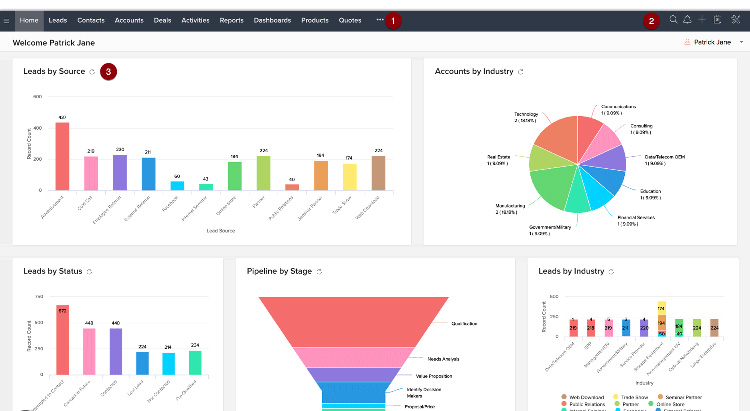
Choosing a CRM type may seem like a challenge. However, it is important to remember that an effective CRM can combine all of these functions into a comprehensive solution, as seen in the Zoho CRM tool.
This system offers not only automation and data storage, but also connections to various tools, analytics in the form of reports, and accurate tracking of revenue and sales. When looking for a CRM, considering its ability to encompass multiple functions can make all the difference in the growth and success of your business.
What are the objectives of CRM?
The objectives of CRM are to improve the management of a company’s customer relationships, which in turn contributes to the growth and success of the business. Some of the main objectives of CRM are:
> Customer loyalty and retention: CRM seeks to strengthen ties with existing customers, increasing their satisfaction and loyalty. By understanding their needs and preferences, companies can offer more personalized and relevant solutions, which fosters long-term retention.
> Increased sales and opportunities: By analyzing data and tracking customer interactions, CRM identifies cross-sell and up-sell opportunities. This information enables sales teams to approach customers with appropriate offers, thereby increasing revenue.
> Personalization of the customer experience: By getting to know customers in depth, CRM allows you to tailor messages and services to their specific needs. This creates a more satisfying and unique experience for each customer, generating a deeper bond and attracting new prospects.
> Communication optimization: Facilitating more effective communication with customers. By having a complete record of past interactions, companies can provide quick and accurate responses, improving customer service.
> In-depth knowledge of the customer and their history: CRM enables companies to gain an in-depth understanding of customer behaviors, preferences and needs. This guides decision making and strategic planning.
> Improved internal efficiency: CRM automates tasks and processes, reducing manual workload and allowing teams to focus on higher value activities. This increases operational efficiency and frees up resources for other initiatives.
Watch our Webinar on CRM to automate your marketing!
How to create a successful CRM strategy?
To develop an effective CRM strategy, it is essential to consider your goals and the choice of the right type of CRM. To do this, we advise you to follow a series of phases:
- Identification of weaknesses
The first step to building a successful CRM plan is to detect the areas in which your team faces day-to-day challenges and difficulties. By doing so, you’ll gain an understanding of precisely what issues your CRM software needs to address. For example, salespeople may lack visibility into the sales process or support agents may not be able to prioritize incoming requests. In either case, it is crucial to involve the professionals who will interact with the CRM on a daily basis in the analysis process, allowing them to contribute their perspective on the solution.
- Verification of compatibility with existing tools
The next step in a successful CRM plan is to ensure that the software is compatible with the tools and systems essential to your business. It’s critical to find a CRM system that is adaptable enough to integrate with platforms already in use, from email inboxes to accounting and order tracking systems. Even if you consider expanding to other types of CRM in the future, it’s essential that your current digital tools can intertwine with other systems seamlessly.
- Look for a solution that is scalable
The third step in realizing a successful CRM plan involves looking for a scalable solution, capable of expanding at the pace of your business. If your company is small, it may seem tempting to opt for cheaper solutions that meet your current needs. However, it is essential to consider whether this choice will allow a smooth transition in case of growth in the coming months, avoiding possible additional costs to make a change of provider. In this regard, we recommend that you look for a provider that is not only affordable for your current operations, but is also prepared to evolve with your business, and with these steps, you will be on your way to creating a solid and adaptable CRM strategy that will drive efficiency and growth for your company.

Benefits of using a CRM in your company
Although the benefits and advantages derived from using CRM will vary depending on their type and the extent of customization implemented, it is possible to highlight a set of common advantages that deserve attention.
- Integral automation of business processes: The implementation of a CRM strategy allows the automation of repetitive tasks and internal processes, freeing time and resources for more strategic and high-value activities.
- More effective data management: With a CRM system, customer data is centralized and organized in a consistent manner, making it easier to access and analyze. This improves decision making and streamlines responses to customer needs.
- Personalized services tailored to the customer: Thanks to the detailed customer knowledge provided by a CRM plan, companies can offer customized services and products, meeting individual preferences and demands.
- Cost reduction in internal processes: The automation and optimization of processes through CRM reduces operating costs by minimizing human errors and streamlining operations, which translates into efficiency and savings.
- Increased customer retention: The ability to deliver personalized and satisfying experiences contributes to target audience loyalty, which increases retention and decreases churn rates.
- Improved customer experience: Personalization and efficient customer service improves customer perception of the company, leading to a positive experience that fosters loyalty and positive word-of-mouth.
- Empowering internal organizational communication: CRM allows teams to share information about customers, which strengthens collaboration and internal communication, avoiding duplication of efforts and inconsistent interactions with customers.
- Process optimization for increased productivity: The automation and efficient management of processes through CRM increases employee productivity by reducing manual workload and facilitating the completion of tasks.
- Facilitating data-driven, informed decisions: Data stored and analyzed in the CRM provides valuable information for decision making, leading to better strategies and positive outcomes.
- Empowering enterprise sales: The personalization and segmentation enabled by CRM allows sales teams to target prospects more accurately and effectively, increasing sales opportunities and business growth.
However, what complicates choosing the right CRM for your situation?
The primary reason for this is the sheer number of CRM options available on the market. In addition, price variations can be significant, which adds an additional element of complexity to the choice process. You need to have a thorough understanding of your industry and the characteristics and needs that come with it. For example, a CRM for real estate involves a constant flow of information that requires more process optimization than in any other business.
Empower your strategy with our CRM consulting!
At Agencia Reinicia, we can give you full support in the configuration of Zoho CRM. Our services range from initial set-up, customization and development of the platform according to your specific business needs, to synchronization with other tools and systems. In addition, we provide training and education to make sure your team gets the most out of Zoho CRM.
We will collaborate side by side with you to optimize your business workflows, improve your data management and boost your bottom line. You can fully rely on our experience and expertise to drive your business success through Zoho CRM.
Complete guide to Zoho CRM: services, pricing and more.