The years 2011 and 2012 saw a boom in social media and its activity, as well as its impact on search programs and therefore to SEO. Google began to introduce more social factors into its results and Bing immediately followed suit. For example, the more connections a user had on Twitter, the greater their power of influence and diffusion, so being shared by such influencers was very beneficial to improve our search engine results. However, in 2013, Google was blocked from accessing Twitter and Facebook and from that moment on, they wondered if it was really worth investing time and money to take into account social signals without being able to ensure permanent access to that information.
And in 2014, Matt Cutts, in response to a question, made Google’s position on the matter clear:
- “A Facebook or Twitter page is treated the same as any other page.” We assume the same goes for Google Plus.
- There is no causal relationship between a page that has been linked to many times from Facebook and Twitter and search engine rankings. It is rather a correlation. That is, it is more likely to have achieved a better positioning by the simple fact that a content is good, which is why it has achieved more sharing on social networks and also inbound links, but only the latter are the ones that have managed to improve the positioning.
What can you do to improve your Social Media presence for the benefit of SEO?
Despite these changes, it would not be a good idea to stop working with social networks, not only because they are a good marketing tool in themselves, but also because there are other ways to get them to help you rank better in search engines. The most obvious are the following:
Brand awareness [branding strategy] 2.
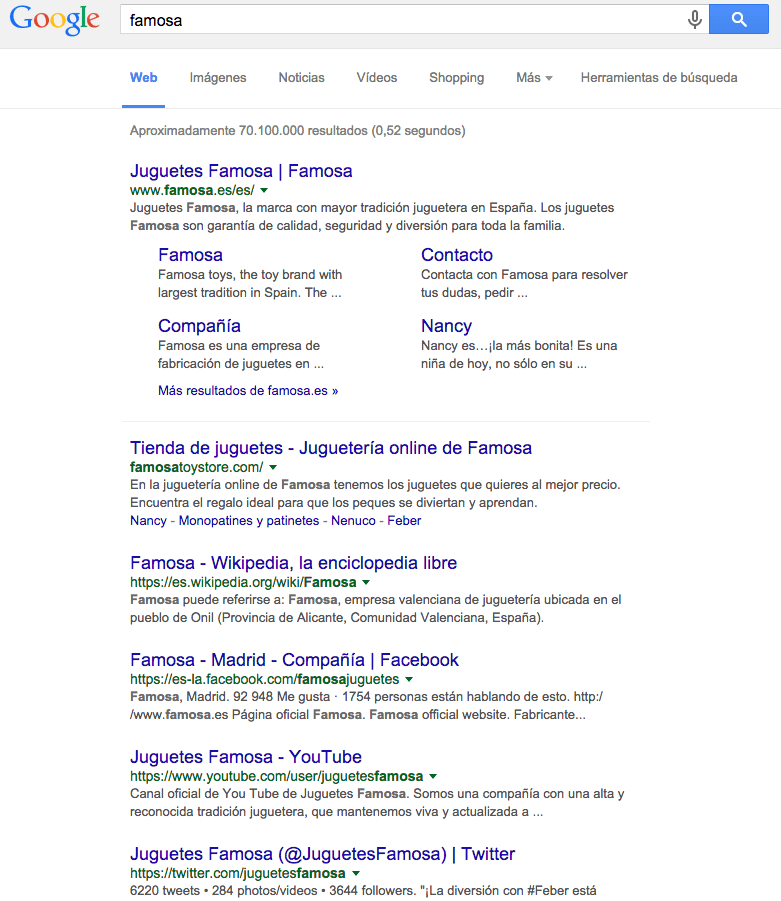
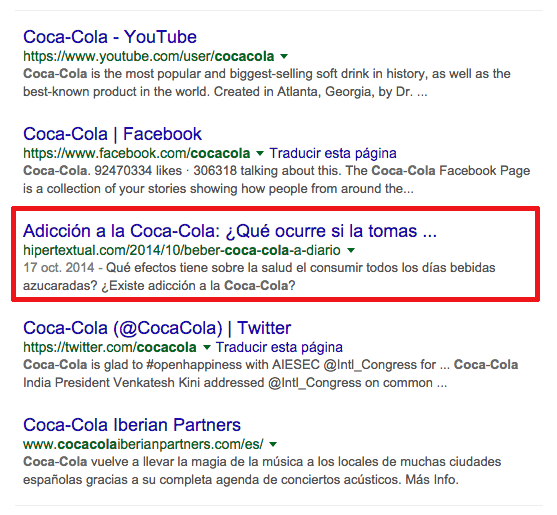
Social media profiles are ideal for covering search results in search engines related to the brand of our company, service or product.
Creating profiles in different social networks and publishing content once or twice a week will help you to ensure that when someone searches for your company’s brand or your products, these results appear as relevant. This, which seems silly, is not at all, since will allow you to control the results that appear in a search engine like Google and above all, avoid that negative information of your brands may appear on third party pages that you do not control, which could be a high cost for our image and throw away part of our marketing efforts.
There are a multitude of tools on the market for good social network management, some with free versions that will allow you to make a moderate investment. To mention a few: Hootsuite, Social Mention, Topsy, Rankur and Sentisis.
Google Knowledge Graph
Don’t you know what we’re talking about? Well, you’re already late. We are talking about Google’s system for organizing and managing information related to millions of “entities” in real life, such as yourself, the company you work for or your favorite website. To do this, it uses different sources, but in the case of certain types of information, who better than yourself to give it to Google. Or so they thought…
For that reason, Google provides us with a means to inform you of certain information if we wish to do so. That is:
- Logo
- Means of contact
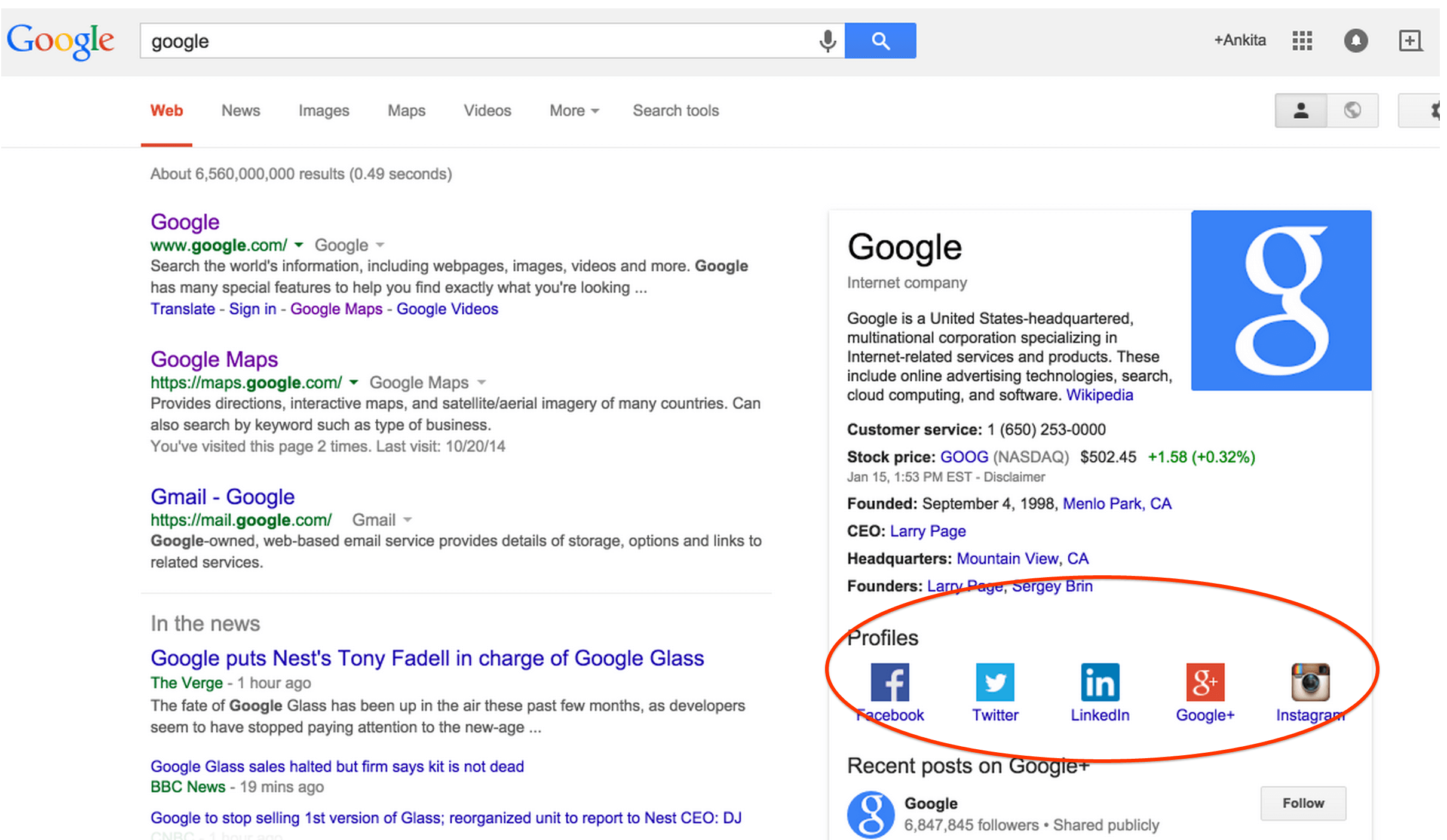
- Social network profiles
And the latter is the one that comes to mind in this article. Google allows us to inform you of social profiles about us or our company. And how does this benefit us? Well, this information will be presented in the form of images in Google results for certain relevant searches, which will undoubtedly improve the %CTR[Click Through: Number of clicks between the number of times a page is printed in the search results] and again, we will be protecting our brands.
To do this, you only have to mark this information at the code level on a page of your website, as indicated by Google on its help page. This markup is a standard, so any technician that is managing the website can do it without problems. You can see complete information about the information markup on the Schema page and also for the markup of social profiles.
3. Get more and better quality links
Although, as we have already mentioned, links from Social Networks do NOT count for link-building with respect to Google, it is true that viralizing the contents through them will make it more likely to get links from sites that the search engine can crawl.
To improve this aspect, it is important to provide the people who visit your site with tools to share the content they have liked. And for that, nothing better than the classic “Share on Social Networks” buttons. Although each visitor will be able to share it by putting the text they consider, it is very important to configure it in such a way that by default a title, description and image that have enough hook will be suggested to them. If you do not know how to do it, we leave you three interesting articles where they explain how to do it:
- Optimized Opengraph labeling
- Influence of image size on the %CTR
- Influence of links in images to improve %CTR
In the same way that share buttons facilitate the virality of content and get links on other sites, social media follow buttons will allow you to convert visitors to your website into followers on social networks. This will make it easier for you to reach them more frequently without the need for them to visit the site, increasing the likelihood that will share it and help generate links. Therefore, it is important to put these calls to action well visible on the site and always in the same place. The higher up and to the left, the greater the visibility and the higher the number of conversions we will achieve.
Of course, it makes no sense to put the “Follow on Social Networks” buttons clearly visible on the web, if you are not updating your profiles with quality content.
4. Google Plus
Another case apart is Google Plus. Being Google’s own social network and having access to ALL the information without restrictions, it is used to show certain information that improves the %CTR in search results and probably in this case it does take into account who shares the content and how many times it is shared within Google Plus, although we could not assure you the latter .
One of the most basic ways to take advantage of this social network in search results is to create a Google Plus page and link it to Google My Business. This way, every time someone searches for your business, your data will appear more visibly on the right side of the search results:
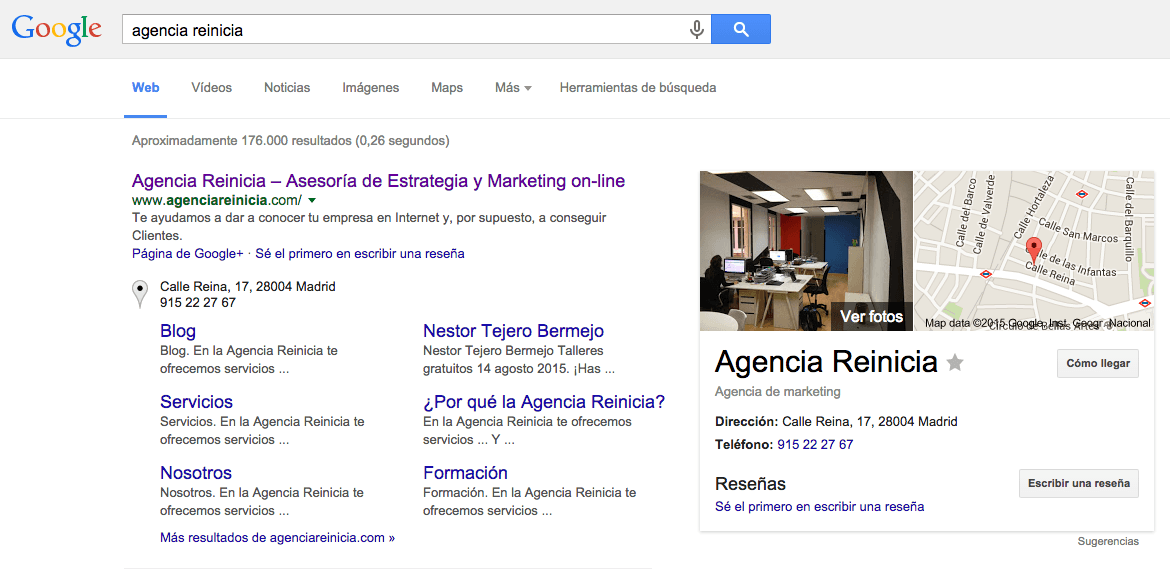
You can see in more detail how to do this by reading the Google My Business article we wrote some time ago on the Blog.
5. Early detection of new content
Although we have already mentioned that posts shared on social networks are not considered as link-building links by search engines and therefore do not have the same importance, there is evidence that posts shared on Twitter, for example, help Google to detect such content early. In fact, Matt Cutts makes this clear in a video from 2011: