Companies are increasingly recognizing the need to manage their data volumes effectively to ensure their performance. In this context, the implementation of Artificial Intelligence in CRM emerges as a key tool.
This technology facilitates the understanding and interpretation of the information collected, providing a real-time view of all interactions with customers. The purpose is to forge stronger and more efficient relationships at every stage of the process, culminating in an agile connection between the brand and the customer. This approach translates into increased productivity, revenue, customer satisfaction and loyalty.
It’s time to welcome intelligent strategies in your business!
Why does your business need AI in its CRM?
A CRM system is designed to understand and plan strategies that drive conversion and sales of a company’s customers. Its primary function is to collect information from a variety of sources, such as emails, orders and forms, to identify behavioral patterns and customize offers to specific customer segments.
The integration of artificial intelligence has significantly boosted CRM performance, offering a holistic view of the user experience, from acquisition to retention. This contributes to a stronger and more successful commercial strategy. An AI-powered CRM makes it possible to identify areas for improvement in customer service, ensuring a more satisfactory experience.
Automation of key tasks is essential to achieve objectives, as the software can perform both administrative functions and data analysis. This capability not only saves time and reduces costs, but also optimizes efficiency and provides valuable insights to personalize the customer experience in digital channels, reducing decision bias.
This combination makes it possible to discover new growth opportunities and anticipate market trends. In short, integrating artificial intelligence into a CRM optimizes both the sales process and the customer experience.
Attend the free AI + CRM webinar to accelerate your business!
Main advantages of AI in CRM
Before delving into the many benefits that artificial intelligence brings to a CRM system, it is crucial to stress the importance of proper preparation. The effectiveness of implementing AI algorithms in a company’s CRM depends on the prior identification of various data sets. These sets, when combined, map a complete customer typology, allowing to optimally respond to the unique needs and preferences of each customer.
Through data analytics and machine learning, interactions with each customer can be personalized, taking into account factors such as purchase history, demographic group to which they belong or browsing behavior. With this solid foundation, let’s explore the main advantages of integrating AI into a CRM to boost efficiency and customer satisfaction.
- Optimization of new customer acquisition
The integration of artificial intelligence has proven to be a valuable resource in the formulation of strategies aimed at attracting and acquiring new customers, as well as generating qualified leads. Its ability to analyze large volumes of data and extract relevant information makes it an essential ally in this process.
When it comes to creating strategies for customer acquisition and qualified lead generation, artificial intelligence is the ideal partner. By combining acquisition and remarketing campaigns with customer clustering, it is possible to design more focused and precise campaigns, transforming visits into successful sales.
- Increased sales
This advantage represents one of the most notorious and valuable benefits for any company. Artificial intelligence makes it possible to process considerably larger volumes of data .
This data, when properly analyzed, becomes knowledge, providing accurate information on aspects such as purchasing trends. Ultimately, this information is used to make more informed decisions and optimize the sales process, campaigns andcustomer interaction.
- Task automation and time optimization
AI enhances CRM’s ability to perform tasks faster and more accurately than humans. This enables increased automation of repetitive or routine processes, such as data entry or retrieval, which significantly reduces manual workload and errors by employees.
This increased efficiency translates into greater productivity and job satisfaction, allowing employees to focus on higher-value tasks, such as building customer relationships and optimizing their sales funnel.
In addition, virtual assistants or chatbots play a crucial role in automating administrative tasks or basic support functions. Well-trained chatbots can answer frequently asked questions, provide product recommendations, follow up on orders, manage contacts, take notes and even process simple transactions.
- Increased loyalty
A satisfied customer tends to be loyal. Therefore, having knowledge of the emotional state of customers enables the creation of a more effective communication strategy, the ability to act proactively and the optimization of the customer experience.
In this perspective, artificial intelligence tools can collect, analyze and visually present how customers perceive the products and services you offer and the way you communicate with them.
In this case, the use of chatbots can analyze and assess customer conversations, identifying and evaluating their feelings, including satisfaction and frustration. Understanding customers’ emotional states can increase revenue per customer by 10%.
- Specific segmentation
Artificial intelligence-driven CRM systems simplify the process of categorizing customer data into defined segments. This enables the creation of highly specific audience segments, tailored to the particular objectives or outcomes the company is seeking, considering geographic, demographic, psychographic, behavioral and sentiment analysis data.
By gaining a deeper understanding of its customers, a company can tailor the interaction and thus improve the effectiveness of planned actions, whether it is tracking an order or promoting a product or service. An example of the application of artificial intelligence in marketing is the generation of personalized messages or experiences based on each customer’s profile.

- Improve customer experience
Gaining a deeper understanding of the target audience’s expectations is essential to establish an emotional bond between the brand and the customer. In this context, the customer perceives that his needs are understood. Beyond just satisfying their specific demands with personalized offers, the goal is to strengthen their loyalty and long-term commitment through strategically designed actions.
This approach is known as “hyper-personalization of the experience” and is essential for implementing effective customer loyalty strategies. By having a deep understanding of their needs, companies can offer specific product recommendations tailored to their demands.
In improving the customer experience, the development of enhanced applications with more intuitive and user-friendly interfaces also plays a crucial role. This ensures a high-quality experience that undoubtedly contributes to boosting conversion rates and sales.
- Reduction of the abandonment rate
Artificial intelligence-driven tools have the ability to recognize patterns and trends in the reasons that lead to churn. This allows the company to take a predictive approach, implementing strategies designed to reduce churn. It is important to remember that retaining a customer is easier and, above all, less costly than acquiring a new one.
Thanks to the application of AI in a company’s CRM, it is possible to keep data better optimized, avoiding inaccurate predictions and enabling the detection of potential problems. Artificial intelligence also suggests personalized actions to solve them, such as identifying and correcting incomplete or duplicate data by consulting other channels.
More than 90% of companies with ten or more employees use a CRM to optimize their processes and improve efficiency. This underscores the relevance that the integration of artificial intelligence and CRM powers data analytics, providing additional value to the continuous improvement of business efficiency.
Artificial Intelligence applications in your CRM strategy
The incorporation of artificial intelligence in CRM is highly beneficial to companies at any stage of their development, significantly improving various areas both internally and externally. Here are some of its key applications:
- Accelerated content production: By processing massive amounts of data, such as emails, comments and reports, AI can generate accurate content to create effective communications.
- Recommendation systems: By thoroughly understanding customer needs, AI recommends specific products according to their demands, thus optimizing the personalization of the customer experience. According to Salesforce, this personalization can increase sales by 10%.
- Sales forecasting: The core area of CRMs is sales, and AI significantly improves forecasting accuracy by processing data. This allows companies to adjust strategies and optimize their sales.
- Predictive lead scoring: AI assesses a customer’s readiness to buy, focusing efforts on potential prospects and providing insights on won and lost business.
- Virtual assistants: AI makes it easier to manage routine tasks, such as managing calendars, scheduling meetings and making phone calls, by automating various functions.
- Data capture: AI simplifies the capture of customer data from various touch points, such as social networks, SMS and images. It also automates data entry, reducing the time sales reps spend manually entering information.
This combination of AI and CRM is a competitive advantage in today’s business environment, with significant potential to positively impact GDP and generate employment globally, according to a report from IDC and Salesforce.
Tools to optimize your CRM with AI
Zoho and Mailchimp are CRM tools that have gained recognition in the field of marketing and customer relationship management. They share the goal of improving interactions between companies and their customers by offering advanced tools for tracking, automating and personalizing these interactions.
Zoho CRM covers everything from contact and opportunity management tosales and marketingautomation. It incorporates reports and analytics dashboards to evaluate progress in contact management, and integrates with other Zoho and non Zoho applications. Its integration with artificial intelligence has automated some of its multiple functionalities:
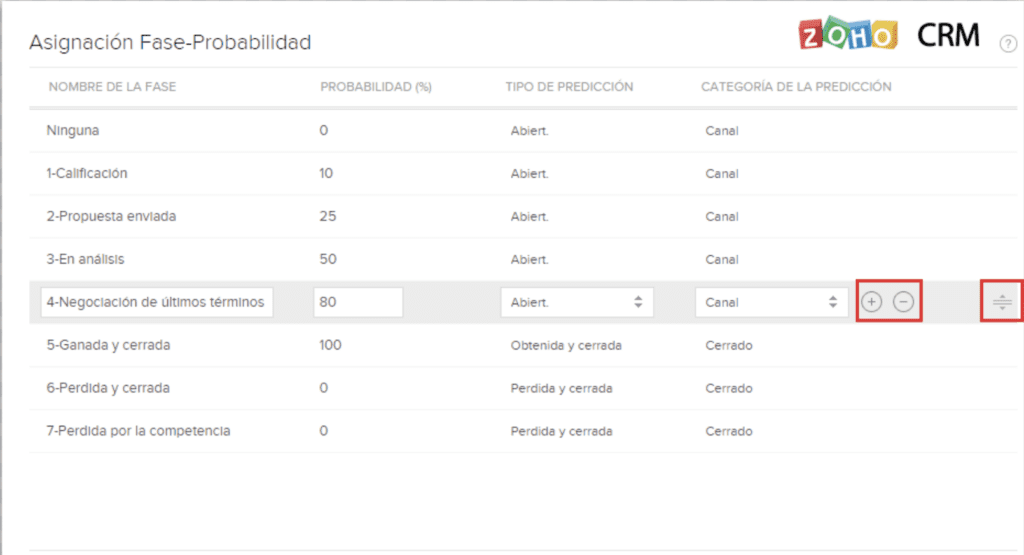
- Advanced forecasting: Provides the ability to examine customer behaviors and sales trends, enabling accurate forecasts of future business performance.
- Intelligent automation: Zoho CRM automates repetitive tasks, from data entry to scheduling alerts and notifications. This automation saves users valuable time, allowing them to focus on other activities, such as interacting with customers.
- Personalized experiences: Artificial intelligence provides personalized recommendations based on customer data, such as buying patterns or product preferences. This empowers users to deliver more tailored and satisfying experiences.
- Intent analysis: Allows you to examine customer interactions with the company, such as emails and calls, to identify intentionality in communications. This capability is used to identify challenges and opportunities for improvement in customer interactions.
Mailchimp, although it also functions as a CRM, is best known for its focus onemail marketing automations. It allows you to create segmented email campaigns, as well as developautomated workflows based on customer behavior, thus ensuring more personalized marketing:
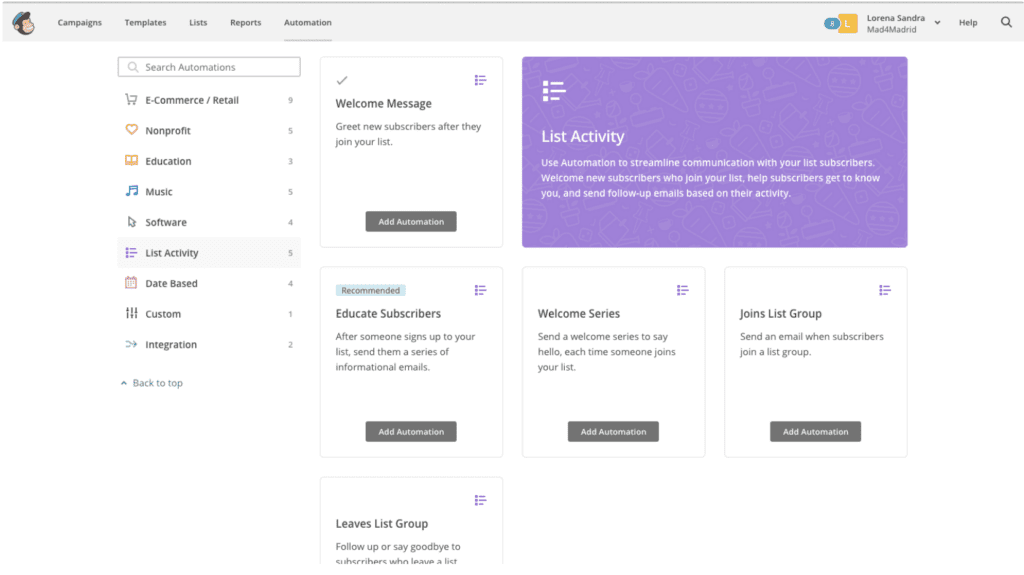
- Optimize content: Analyze your campaigns in detail and provide you with suggestions to improve design and usability, in order to increase the click-through rate of your email marketing campaigns.
- Campaign Benchmarking: This campaign benchmarking feature uses advanced data technology to compare the performance of your email marketing strategy with that of your competitors.
- Creative Assistant: Understands your brand identity and has the ability to generate designs that will increase visibility and traffic for your business. It uses design best practices along with artificial intelligence to ensure that your multichannel campaigns are visually appealing and consistent. Plus, it offers the ease of editing, resizing and publishing your designs with ease.
These two tools are complementary and can be used together to improve interactions with customers throughout their lifecycle. The choice between Zoho and Mailchimp will depend on your company’s specific needs and the way you prefer to approach customer relationship management.
Other Zoho services that include AI
Zoho’s artificial intelligence platform, known as Zoho AI, provides a wide variety of services and tools designed to empower business applications for both developers and users. These services include:
- Zia: A virtual assistant that simplifies tasks in applications such as CRM, Human Resources and Finance, improving user efficiency.
- Zoho Desk: Customer service platform that leverages artificial intelligence to optimize the interaction of support agents with customers, ensuring a quality experience.
- Zoho Campaigns: It is the best ally for your email marketing campaigns. As a CRM it is very complete and that also requires more knowledge to manage it.
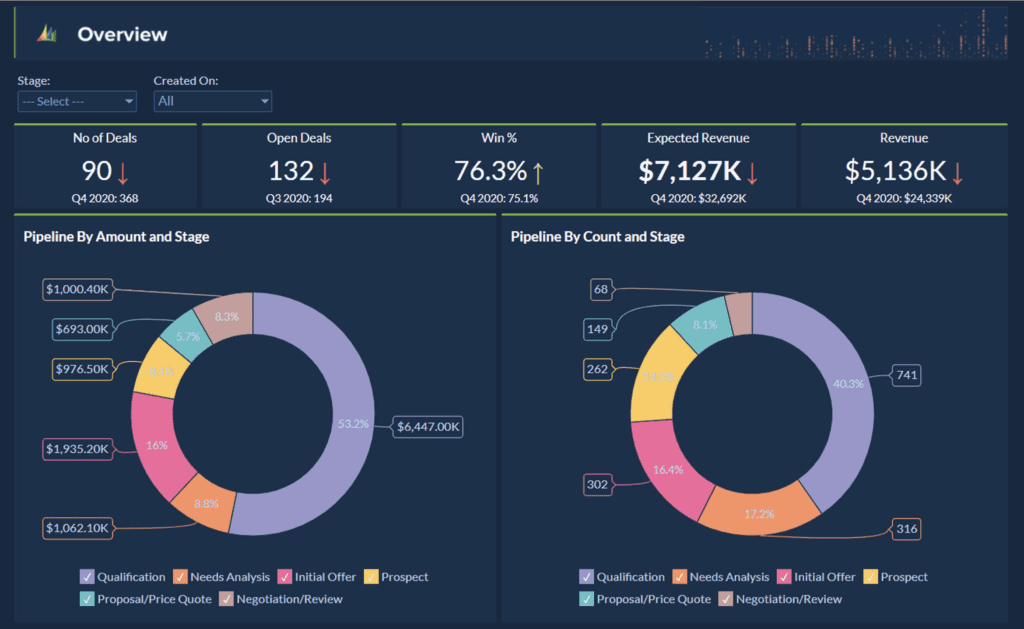
- Zoho Analytics: Data analytics tool that uses artificial intelligence to extract relevant and insightful information from business data.
- Zoho Invoice: Invoicing solution that automates the process of issuing invoices, reducing errors thanks to artificial intelligence.
Zoho maintains its commitment to continuous development in the field of artificial intelligence, with the aim of improving the user experience and offering more intelligent and personalized products.
At Reinicia, as Zoho partners, we are here to help you get the most out of these applications. From initial configuration to process automation, through training your team and any questions you may have, we are at your disposal! 😉