In an increasingly digitalized and customer-centric business world, management tools such as CRM (Customer Relationship Management) and ERP (Enterprise Resources Planning) systems have become key pillars for the success of companies. These systems not only optimize internal processes and improve customer relations, but also represent a significant leap towards efficiency and effectiveness in the era of digital transformation.
Understanding the difference between CRM and ERP is crucial for any business leader looking to implement effective management solutions in their company. Although both systems are designed to increase profitability and improve the operability of a business, they focus on distinct and complementary areas of management. In this article, we will explore in detail the features, functions and benefits of each of these systems, helping to clear up doubts about which one is more suitable for your company’s specific needs.
What is a CRM?
CRM (Customer Relationship Management) is a fundamental tool for customer relationship management. It aims to put the customer at the center of the company. It facilitates the collection and organization of customer information, which is crucial for effective marketing strategies and driving sales.
There are several types of CRM that can be adapted to your business based on the solutions you need. These are Operational, Analytical, Collaborative and Strategic CRM.
CRM main features
CRM stands out for its ability to automate sales processes, facilitating an effective and personalized commercial follow-up. It is a dynamic tool that significantly improves customer satisfaction.
- Data centralization: One of the key features of a CRM is the ability to centralize data related to customers and prospects. This means that all relevant information, from contact data to interaction histories, is stored in a single platform accessible to all teams.
- Process automation: Modern CRMs incorporate automation tools that simplify and streamline numerous business processes. From lead tracking to sending personalized emails, automation frees up time for teams to focus on more strategic activities.
- Sales management: CRM facilitates the tracking of sales opportunities and the performance of sales teams. With functionalities such as sales funnel management and task assignment, the process of converting leads into customers is optimized.
- Analytics and reporting: The ability to analyze data is essential. CRMs provide advanced analytical tools that allow you to evaluate performance, identify trends and make informed decisions. These reports can range from sales metrics to customer behavior.
Impact of CRM on customer relationships
The implementation of a CRM is essential to create refined marketing strategies. It allows for better segmentation and personalization in communication with customers, leading to increased conversion and loyalty.
Effective CRM implementation has a significant impact on customer relationships. By consolidating information, companies can offer more personalized and relevant experiences. Efficient information management also makes it possible to anticipate customer needs, improving customer satisfaction and loyalty.
In addition, process automation streamlines responses to inquiries and requests, contributing to the perception of faster and more efficient customer service. Effective sales management results in shorter sales cycles and a more proactive approach to business opportunities.
Attend the free webinar on Omnichannel CRM to empower your business!
What is an ERP?
ERP (Enterprise Resources Planning), on the other hand, focuses on enterprise resource planning. It is a comprehensive solution that manages various aspects of a company, such as accounting, human resources and inventories, aiming to optimize internal processes and improve efficiency.
Essential ERP Functions
An ERP is characterized by its focus on the back office, managing the company’s internal information. It controls processes such as invoicing, payroll administration and stock control, and is essential for efficient management.
- Process integration: ERP excels in its ability to integrate and unify key business processes. From inventory management to accounting and human resources, an ERP eliminates data silos by providing a centralized platform that connects different departments.
- Inventory and logistics management: A crucial aspect of ERP is its ability to efficiently manage inventories and logistics processes. It enables real-time tracking of stock levels, facilitating informed decision making and reducing costs associated with inventory management.
- Financial process automation: ERP simplifies and automates financial tasks, from invoicing to bank reconciliation. By integrating accounting, companies can more easily generate accurate financial reports and comply with regulatory requirements.
- Human resource management: Human resource management is another key function of an ERP. It allows you to manage employee information, from hiring to performance management, centralizing data that facilitates strategic personnel decision-making.
ERP and internal resource management
The impact of ERP on internal resource management is profound. By centralizing data and processes, ERP improves communication between departments, resulting in faster and more coordinated decision making. Real-time visibility of available resources enables more efficient task allocation and more accurate planning.
In addition, the automation of processes within the ERP reduces the administrative burden, allowing teams to focus on more strategic activities. Integrated human resources management ensures that companies have the right talent at the right time, contributing to operational efficiency and the achievement of organizational goals.
Comparison: CRM vs ERP
When analyzing enterprise solutions, it is essential to understand the differences between a CRM and an ERP, as both play crucial roles but in different areas of business management. Below, we will explore the areas of focus and the specific benefits of each system.
Areas of focus and benefits
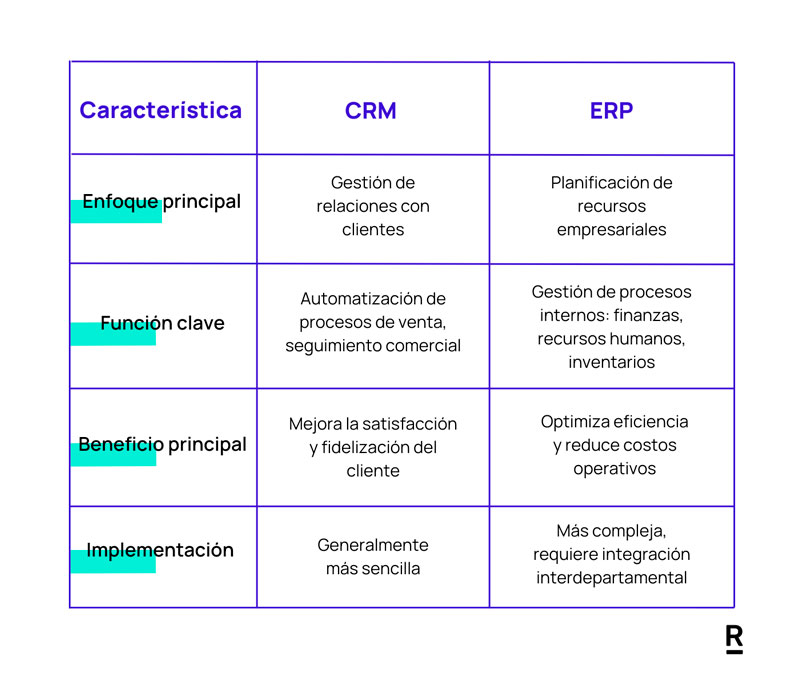
CRM and ERP, although different, are complementary. While CRM focuses on customer relationship management, ERP focuses on internal resource management, both contribute to more effective business management.
- CRM – Customer Relationship Management: CRM focuses primarily on strengthening customer relationships. Its key benefits include better customer understanding, efficient management of sales opportunities, and personalization of interactions. A CRM helps build loyalty and improve customer satisfaction, which in turn drives sales growth.
- ERP – Enterprise Resource Management: On the other hand, ERP focuses on the integration and management of internal business processes. Its benefits range from supply chain optimization to efficient inventory and human resource management. An ERP improves operational efficiency, reduces costs and facilitates strategic decision making.
Comparison Chart: CRM vs ERP
It is important to note that, although both systems have different objectives, some solutions integrate CRM and ERP functionalities to offer a more complete business management. The choice between CRM and ERP will depend on the specific needs of each company and its long-term strategic objectives.
Access CRM consulting to improve your business performance!
CRM and ERP integration in the enterprise
The integration of a Customer Relationship Management(CRM) and Enterprise ResourcePlanning (ERP) system in a company represents a strategic step towards operational efficiency and process optimization. Let’s explore the key benefits of this integration and strategies for effective implementation.
Benefits of integration
The integration of CRM and ERP in a company leads to a more holistic management, allowing access to customer information from anywhere and improving every interaction.
- End-to-end customer and business insight: CRM and ERP integration provides a complete and centralized view of both customer and internal operations information. This allows teams to make more informed decisions by having access to accurate and up-to-date data in real time.
- Improved interdepartmental coordination: By integrating CRM with ERP, the gap between sales and operations teams is eliminated. Communication becomes more fluid, as information flows seamlessly between areas, improving coordination and collaboration.
- Operational efficiency: Integration reduces data duplication and manual tasks by automating processes ranging from lead generation to inventory management. This not only improves efficiency, but also reduces errors and minimizes time spent on administrative tasks.
- Personalizing customer experiences: With consolidated information, companies can more effectively personalize customer experiences. They can anticipate needs, offer more personalized services and strengthen relationships throughout the customer lifecycle.
Strategies for effective implementation
The key to effective implementation is to understand the specific needs of the company and adapt the tools to these needs.
- Requirements analysis: Prior to implementation, it is crucial to conduct a thorough analysis of business requirements. Understanding the specific needs of the business ensures that the integration is tailored to your processes and objectives.
- Selecting the right software: Choosing CRM and ERP solutions that integrate efficiently is key. It is essential to select software that is compatible and has functionalities that meet the specific needs of the company.
- User training and adoption: Proper staff training is essential to ensure a smooth transition. Users must understand how to use the new tools and understand the benefits of integration.
- Continuous monitoring and updating: After implementation, it is crucial to monitor performance and make updates as needed. Technology evolves, and integration must remain relevant to changing business needs.
Successful CRM and ERP integration boosts a company’s efficiency and competitiveness. By adopting these strategies, organizations can take full advantage of the benefits of this combination, driving growth and customer satisfaction.
At Reinicia, as Zoho partners, we are here to help you get the most out of these applications. From initial configuration to process automation, through training your team and any questions you may have, we are at your disposal! 😉