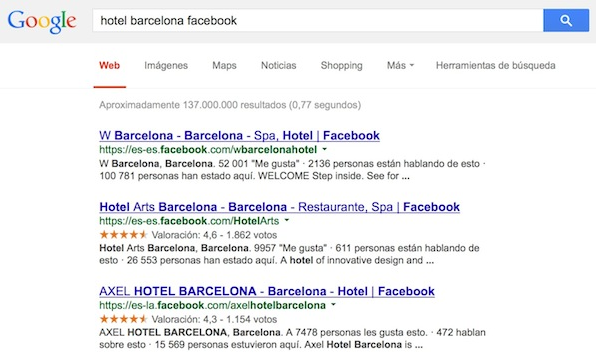
Yes, you heard right, two of the largest Internet companies have reached an agreement so that Google, through its robots, can enter Facebook, crawl public content from the mobile application (the search engine will still not have access to all those contents published privately by users of the social network, so we can rest assured), index them and display them as a result of a search that users make through the search engine. Let’s remember that this already happened previously with Twitter, allowing Google to allow the person who makes a query in the search engine to find accounts and Tweets related to it.
How does Google and Facebook work now?
Let’s clarify a little bit to make it clear. Before, from Google, certain Facebook pages were shown as search results, which ranked the same as any other web page taking into account on-site and off-site factors. If we searched for a certain term and a page had made a relevant post about that term, the page, not the post, could appear in Google’s search results. With this agreement, we will also be able to find individual posts. With a single click users will be able to enter the Facebook application and be directed to the content of their interest. Searches will also work with public groups and events. An important aspect is that for the moment, these will only be visible from Android devices, something that will possibly change to other devices and desktops over the coming months.
This means that, in terms of SEO (for the time being mobile SEO), public information inside Facebook will have to be considered as another factor in Google’s algorithm. In addition, with this agreement, Google will be even more unmarked as a reference search engine that users will use to find relevant information for their searches, and Facebook will gain traffic and permanence of its users within the social network.
In recent years, Facebook has also been improving the functionality and efficiency of its internal search engine to improve search results within the social network, and thus compete with Google’s results, while maintaining the security of users who do not want to have their profile indexed publicly.

What are the SEO implications of this agreement?
Well, for the moment we will focus on the mobile SEO part, since now it does not affect the search results made from desktop computers. It’s very simple, if at this moment from your cell phone you make a query for information through Google (for example: women’s shoes stores in gran via), you will get a number of results. If now, with this agreement, we add all the results from Facebook pages and posts, it is clear that the results will multiply, so the competition will increase considerably.
Consequently, and as improvements to be made in terms of SEO, we can consider the following in order not to be left behind:
- Construction of responsive websites or the creation of a structure or website only for mobile devices.
- Mobile SEO Optimization (If you want to know more about this aspect you can read our article about mobile SEO optimization.
- Optimization of calls to action within Facebook and Twitter posts to drive traffic back to your website.
- In-depth analysis of user behavior through visits to our websites via mobile devices and through social networks.
- Optimization of SEO publications on Facebook and Twitter. How?
How to optimize your Facebook and Twitter page and posts:
- Use keywords (previously researched and with a good competition/search ratio), both within the title of the message of the publications, as well as within the same.
- In social networks such as Facebook and Twitter use hastag with the keywords to position: #redbags, #womensshoes, #women’sperfumes.
- Include links to pages related to the keywords we want to promote at SEO level.
- Use representative images of the products, services or pages we want to position, with links to them and high quality (in social networks such as Pinterest can improve the intention of click by users). That the name/path of the image includes keywords: women’s-bag-bronze.jpg
- Use URL shorteners such as:
- Bitly https://bitly.com/. With it we can have data on the results of the campaigns or publications that have been made.
- Google URL Shortener: https://goo.gl/ It gives us information about who has opened the link and from where they have done it. Also, an added option is that we can create QR codes of our links. By adding a “+” to any Goo.gl web address, you will be able to visualize your analytics data.
- Use the Open Graph protocol for digital data communication that allows your publications to become rich objects within the social graph. Open graph protocol
5-star Facebook ratings on Google:
For more than a year now, Google has been allowing to display Facebook ratings where, based on the users’ opinions, a rating of the fan page is composed. This may be one of the important aspects to consider to improve the CTR of our search results.