By now, we have all heard about Facebook Ads and its advantages, and the fact is that on average, Facebook has 1.23 billion active users per day, or what could be the same, potential customers per day.
If you want to start using Facebook Ads, the first step is to set the objectives of your campaigns. Here we go!
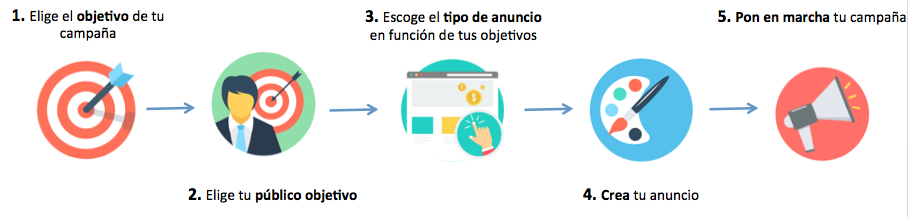 Why is it important to set a goal? Well, because Facebook will optimize the delivery of your ads based on the objective you have, that is, it will show the ads to those people who are more likely to help you achieve your goals, so it will not be the same to choose “get traffic to your website” than “drive traffic to your physical store”.
In addition to technical issues, it is necessary to be clear about the objective of your campaign from a marketing point of view in order to start with our advertising, because if we do not know what we want to achieve, it will be impossible to know if it is working properly or simply to design the concept of the campaign.
At Reinicia we are specialists in Facebook Ads. We help you!
What do we want people to do when they see our advertising?
Next we will see how to define our Facebook Ads campaign according to the objectives pursued.
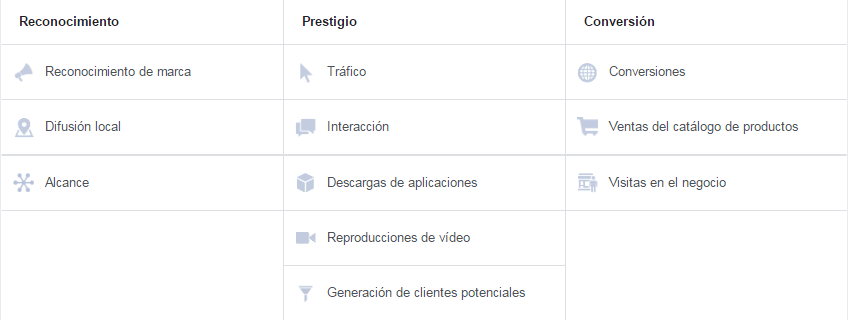
The main objectives to choose from are as follows:
- Recognition
- Prestige
- Conversion

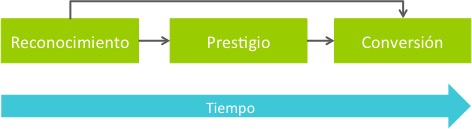
ACKNOWLEDGMENT
Recognition campaigns are campaigns whose objective is “I want people to know about my business“. And that’s going to be the main objective, not that they will buy or that they might want to buy: I just want them to know that I exist, what I do and how I do it.
Let’s start talking about Carlota and her new business. Carlota has a candy store for celiacs, she just opened her business! In addition to having a physical store, she has an online store through which you can mail to the person of your choice (or to yourself) a package with her sweets, isn’t that great.
As she has just opened her business, Carlota wants to make herself known, so she will choose a recognition target for her Facebook Ads campaign.
Within its recognition objective, it will have the following complementary objectives:
- Brand recognition: reach users who may be related to your brand and who are more likely to pay attention to your advertisement
- Local Outreach: reaching people who are close to your business
- Reach: achieve maximum reach, reaching as many people as possible.
PRESTIGE
The objective of these campaigns goes one step further, and is “I want to find potential customers for my business“, that is, to increase the awareness of your brand among those who are already interested in what you do and who take you into account when deciding on a product or service you offer. In this case, Facebook will look for people who may be interested in your product or service, so that they can sign up for your newsletter, become followers of your fan page or attend one of your events.
Going back to our example, Carlota has been running her online business for a while now, and although more and more people know about the business, she would like people to sign up for her newsletter where she would send them a celiac-friendly recipe a week.
Within the prestige or consideration objective, Carlota will be able to choose between the following complementary objectives:
- Traffic: attracting people to your website
- Interaction: get more people to interact with your page or publication. It can be either interactions with a publication (likes, comments…), Likes on the Facebook page (followers), interest in your events, or requesting an offer or discount.
- Increase your application installations
- Increase video views
- Generate leads for your business: get registrations or information from people who may be interested in what you do or sell.
CONVERSION
And finally, this will be the goal when what we are looking for is “I want to increase sales of my product or service“. To measure these campaigns it is important that we install the Facebook Pixel (tracking code) of our campaigns, to know how many people saw the ad and finally bought.
Again in our example, Carlota wants to increase the sales she makes through the website of products for celiacs. To do so, she offers her customers a €5 discount on their next order. In this case, she can choose between the following complementary goals for her conversion campaign: not only online conversions, but also in-store conversions.
- Conversions: to increase sales – this can be through coupons, discounts, or special offers.
- Product catalog sales: with this type of ad you will show potential customers different products from your product catalog.
- Visits to the business: increase the number of visits to your business, reaching people who are close to one or several locations of the business.
What advertising can I use depending on the target I choose?
As we mentioned before, the objectives we choose will “restrict” the ad placements and formats that we can use in our ad.
Below is a table so that, once you have decided the objective of your campaign, you can easily know where and how you can promote it:
RecognitionAdditional objectivesPlatformAdvertising format
| Brand recognition | Facebook |
Photo Video Carousel Slideshow Canvas |
|
| Local Diffusion | Facebook |
Photo Video Carousel Slideshow Canvas |
|
| Scope | Facebook |
Photo Video Carousel Slideshow |
RecognitionAdditional objectivesPlatformAdvertising format
| Traffic | Send people to your website Get them to download your app |
Facebook |
Photo Video Carousel Slideshow Canvas |
| Interaction | Get interactions (Post engagement) Get Likes on your Facebook page (Page likes) Ask for an offer or discount (Offer claims) Get interested in your events (Event responses) |
Facebook Audience Network |
Photo Video Carousel Slideshow |
| Application Downloads | Facebook Audience Network |
Photo Video Carousel Slideshow |
|
| Video views | Facebook Audience Network |
Video Slideshow |
|
| Lead generation | Photo Video Carousel Slideshow |
| Conversions | Facebook |
Photo Video Carousel Slideshow |
|
| Product catalog sales | Photo Carousel |
||
| Visits in the business | Photo Video Carousel Slideshow |
Now that you know all the options that Facebook gives you, it’s time to start your campaign! As we said at the beginning you don’t need a big budget, you can analyze the results and optimize your advertising until you get an ad that achieves your goals. Good luck, if you have any other advice or questions let us know in the comments, we will be happy to help you!