Keyword research is a fundamental part of any marketing strategy, and learning how to find the right keywords is much easier than you think and you can do it for free! Below we will see some tools that will help you find from the most specific keywords (long tail) to the most generic ones to start working your SEO strategy and be present in the whole search process of your potential customers. But first let’s clarify something: what are long tail keywords? Let’s take a look at this graphic:
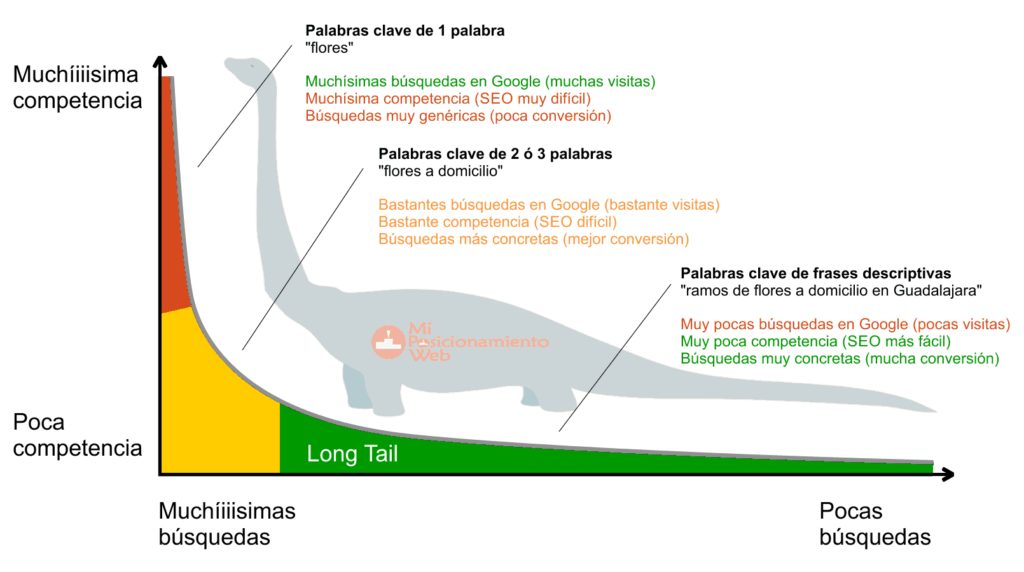
Source: miposicionamientamientoweb.es
When we have a business, for example an online sneakers store, we want to be perfectly positioned for very specific searches of users who have already made the decision to buy or hire a service: “buy Nike Air Force sneakers”. These are the long-tail words, very specific and converting words for your business. If you appear in the first results for these types of searches, great, you are doing something very well. But that’s not all, you have to work on other searches!
When searching for keywords used by our target audience, it will also be important to take into account the users’ search intention. From this point of view, keywords can be classified as follows:
- Navigational: Users search for a specific brand. For example: telepizza, movistar tariffs, etc.
- Information search: The information itself is the user’s primary objective. Sometimes they are prior to the purchase of a product. For example,“How can I make my computer go faster?”
- Transactional: These involve a conversion, not just a transaction. For example, Italian restaurants in Madrid, buy a microphone, rent a studio, etc.
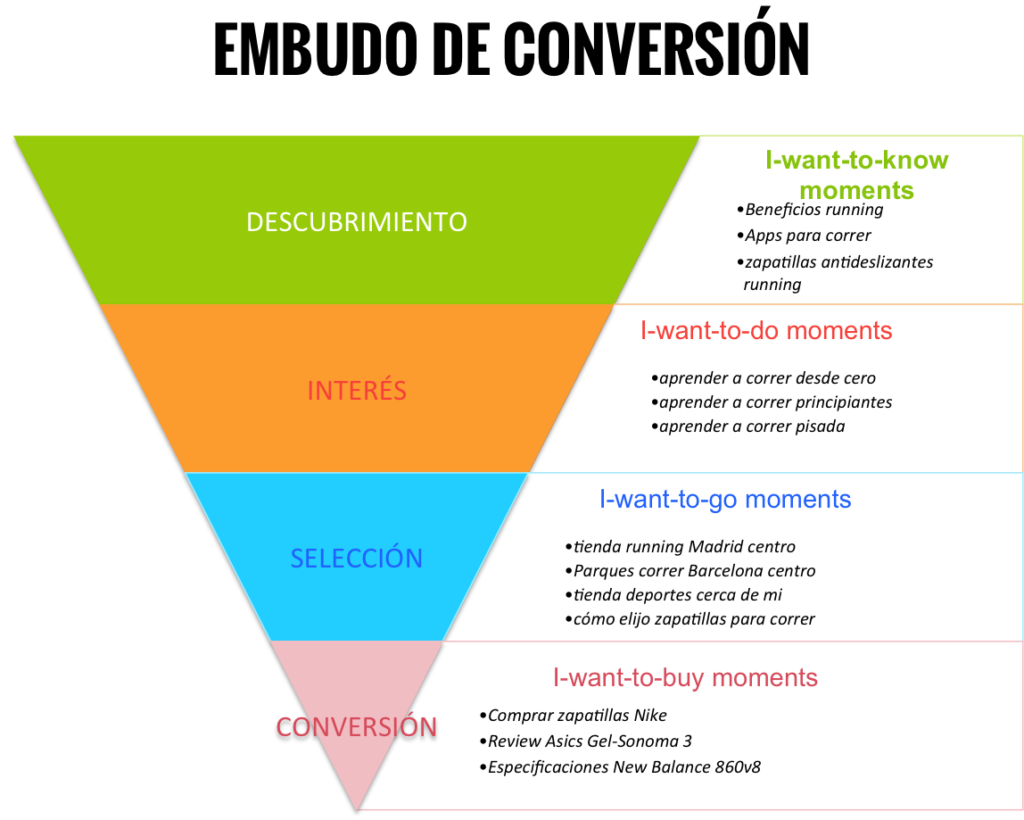
Another way we have to identify relevant keywords for our business are the so-called micro-moments. With the emergence of mobile devices, we have changed the way we live and relate to brands. This new reality has caused consumers to base their decision-making process on small instants of time that happen in real time: micro-moments. Each one of them is a unique opportunity for brands to influence consumer decisions and preferences, and that is why a good keyword structure will be very useful for your business. Google defines 4 types of micro-moments. Some examples of micro-moments:
- I-want-to-know moments: people who are researching, exploring or looking for inspiration.
- I-want-to-go moments: people who are looking for a local business for a product or service.
- I-want-to-do moments: People who are looking for help to do something. It can be before or after the purchase.
- I-want-to-buy moments: people who are already clear about what they are going to buy, but have doubts about what or how.
Once we understand the type of keywords we want to search for, which keyword research tool can we use?
1. Google Keyword Planner
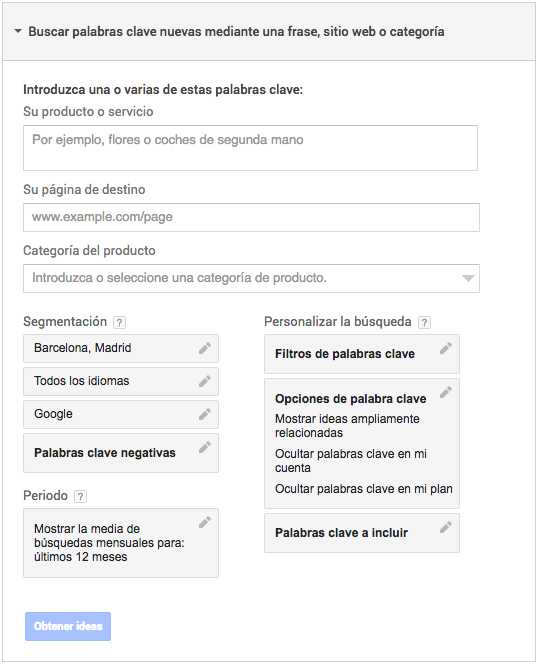
The Google Keyword Planner is, without any doubt, the most complete and flexible tool we can use for keyword analysis and allows us to make different estimates and searches according to countries, cities, languages, etc. It also allows us to save our analysis for another time and even add the keywords directly to our Adwords campaign. What is its flaw? That we can not know the quality level of the keyword, but as an analysis tool, as you can see, it is very complete.
How to find new keywords and their search volumes? This tool offers three options:
- Search for keywords using a phrase, word, product or service, from which we will obtain related words.
- Search for keywords by adding a landing page or website, from which it will return ideas or suggestions.
- We can use categories that Google has saved to give us suggestions and opportunities.
This tool also allows you to obtain search volume data and trends for a list of words and to combine lists of keywords to obtain new keywords.
2. Keywordtool.io
On its website we can access a keyword researcher that gives us ideas not only for Google, but also for other search engines such as Bing, Youtube, Amazon, or the App Store. It is a paid tool, although you can use the free version with some limitations.
What do we like about this tool? In addition to the data and keyword suggestions in different search engines, it has a “questions” tab that can be very useful for discovering keywords for information searches.
3. Übersuggest
Accessing its domain ubersuggest.io we will find a tool similar to the previous one, although totally free. One of the utilities that differentiates it from the previous one is that it allows us to sort the words alphabetically, which can be very useful on many occasions. It is a really simple tool and can help us with Long Tail word searches.
4. Google Trends
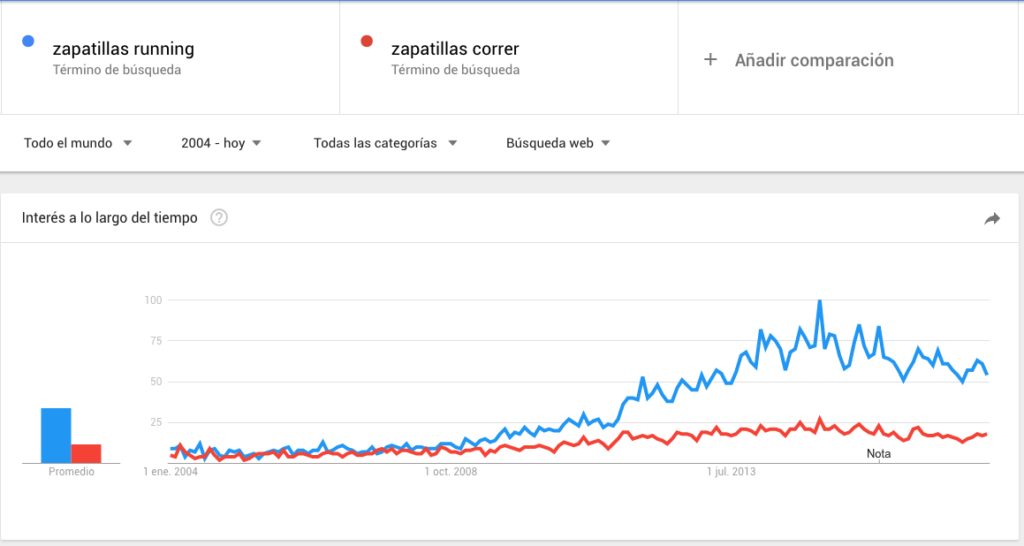
Google Trends, or Google trends, is not really a tool designed for keyword analysis but it can help us to identify search trends over time. It is also useful to compare trends between two or more keywords. In our example, look at the evolution of running shoes vs. running shoes. Interesting, isn’t it?
It is also interesting to discover which keywords are seasonal or cyclical. Once identified, we can also know when the volume of searches for these words starts to increase in order to define when we should start publishing related content to start being in the consumer’s mind at the time of purchase (top-of-mind). This is very useful in Christmas campaigns, trade fairs, Black Friday, or other specific and relevant moments in our sector.
5. Google Instant

Google Instant are basically the suggestions that Google gives us when we are starting a search, as we can see in the image. It is an easy and very useful option for long tail searches, but be careful:the results that appear are not the same for everyone, as they depend on the location and the searches previously performed by the user.
Google Instant is, from our point of view, a good source of inspiration. But it needs to be complemented by other tools that offer search volume and competition data.
6. Related searches

This is another of Google’s tools that, although it is designed for when a user reaches the end of the results page without finding what he/she was looking for, it can be useful for us to expand our keyword analysis. Like the previous tool, it will need another complementary tool for the analysis to be more relevant in our keyword study.
7. SEMrush (paid)
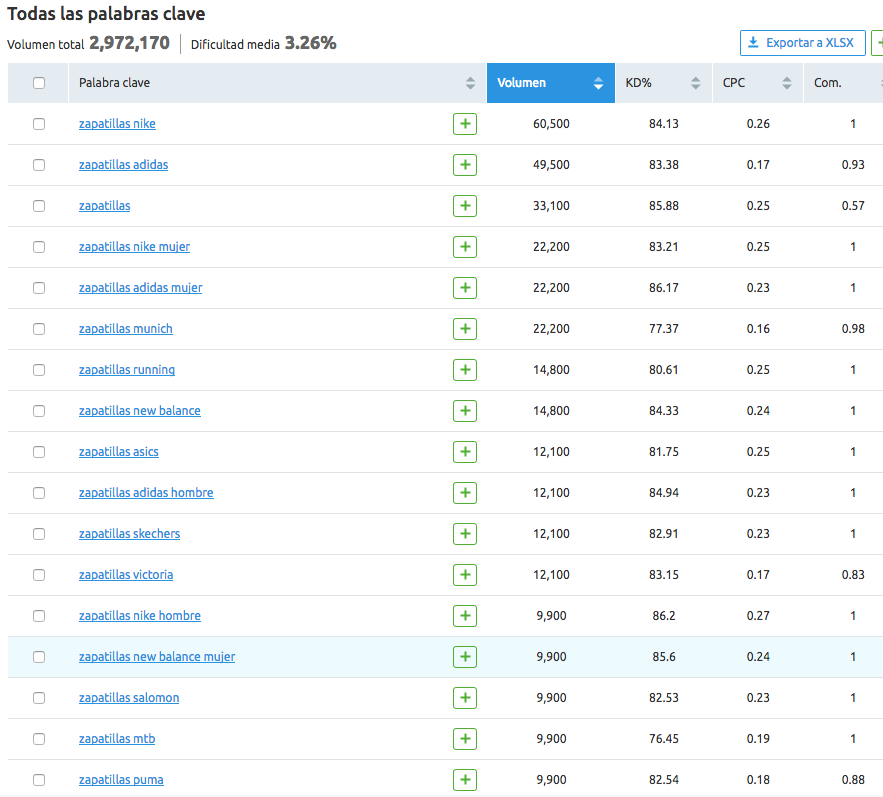
We couldn’t finish our recommendations without talking about SEMrush, which offers both a keyword research tool (Keyword Magic Tool) as well as the possibility to spy on our competitors and see which search terms activate our competitors’ ads. Especially if you are an agency, in our opinion, it is worth a try.
It is a tool that combines organic positioning data (SEO) with paid data, so it also shows us data such as the estimated CPC for each of the keywords. The options of this tool are very wide, and it justifies the cost if you are going to make good use of it.
8. Moz (paid)
Moz is one of the most popular tools for keyword research. One of its advantages is that it can help you estimate keyword difficulty by suggesting terms semantically related to your website’s main keyword.
The data provided for each of the suggestions are: search volume, difficulty, potential and opportunity. It is a very simple and accurate tool. It also has a very powerful blog that will help you select the best keywords and strategies for your business, whether you are a beginner or not.